

Carex scabrata (Eastern Rough Sedge)
| Also known as: | |
|---|---|
| Genus: | Carex |
| Family: | Cyperaceae (Sedge) |
| Life cycle: | perennial |
| Origin: | native |
| Habitat: | part shade, shade; moist to wet; wet woods, seeps, ravines, creek banks |
| Fruiting season: | June - September |
| Plant height: | 10 to 30 inches |
| Wetland Indicator Status: | GP: none MW: OBL NCNE: OBL |
| MN county distribution (click map to enlarge): | 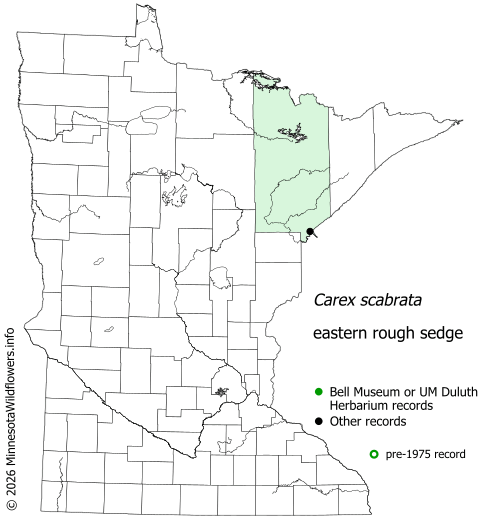 |
| National distribution (click map to enlarge): |  |
Pick an image for a larger view. See the glossary for icon descriptions.
Detailed Information
Spikes: 
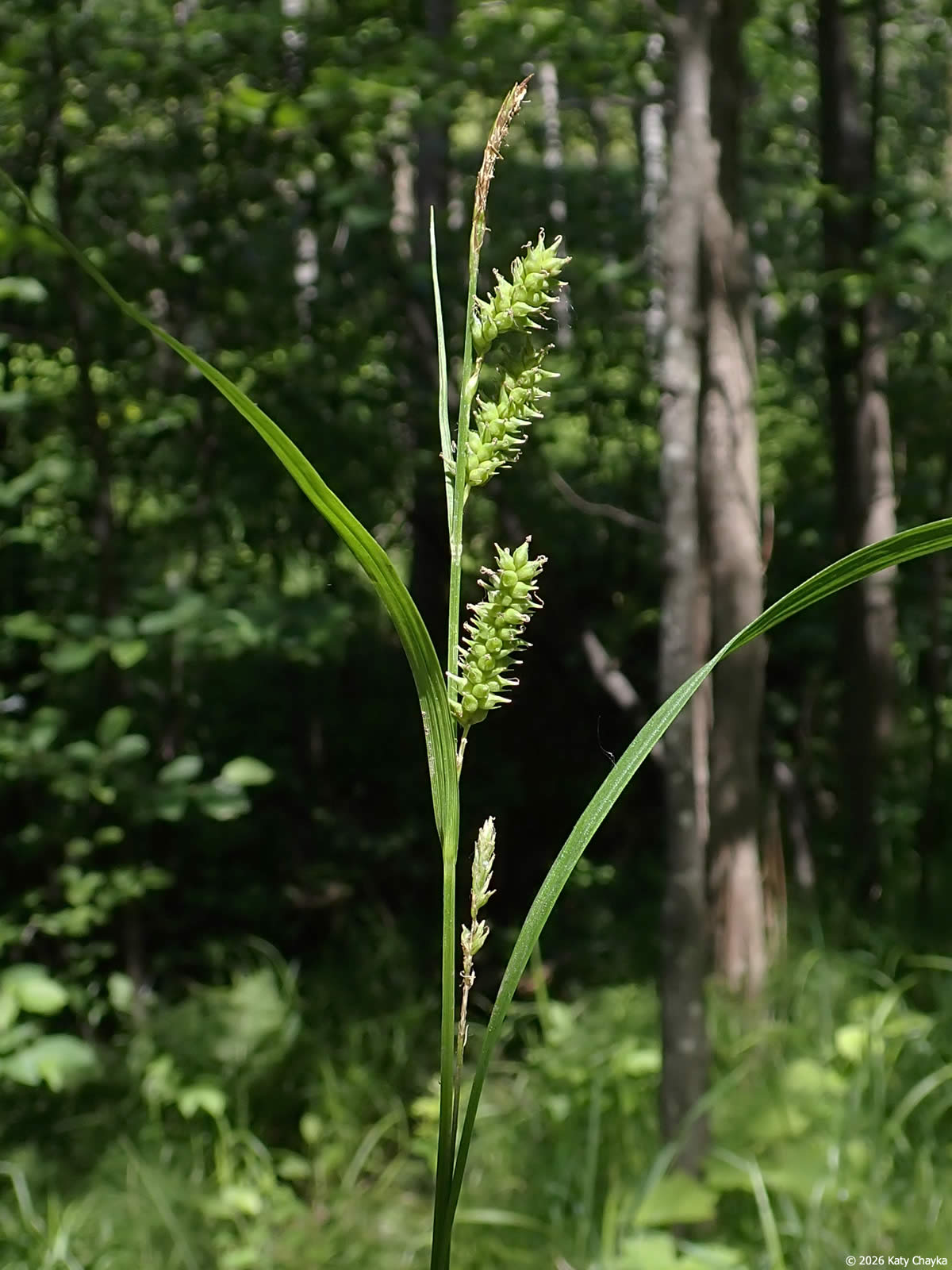 Separate staminate (male) and pistillate (female) spikes, with a single staminate spike up to 2 inches (1.5 to 5 cm) long at the top of the stem. Below the staminate spike are 3 to 7+ erect, cylindric pistillate spikes each ½ to 2¾ inches (1.5 to 7 cm) long. The lowest spike is typically long-stalked, becoming shorter stalked as they ascend the stem; the uppermost spike may be stalkless or nearly so.
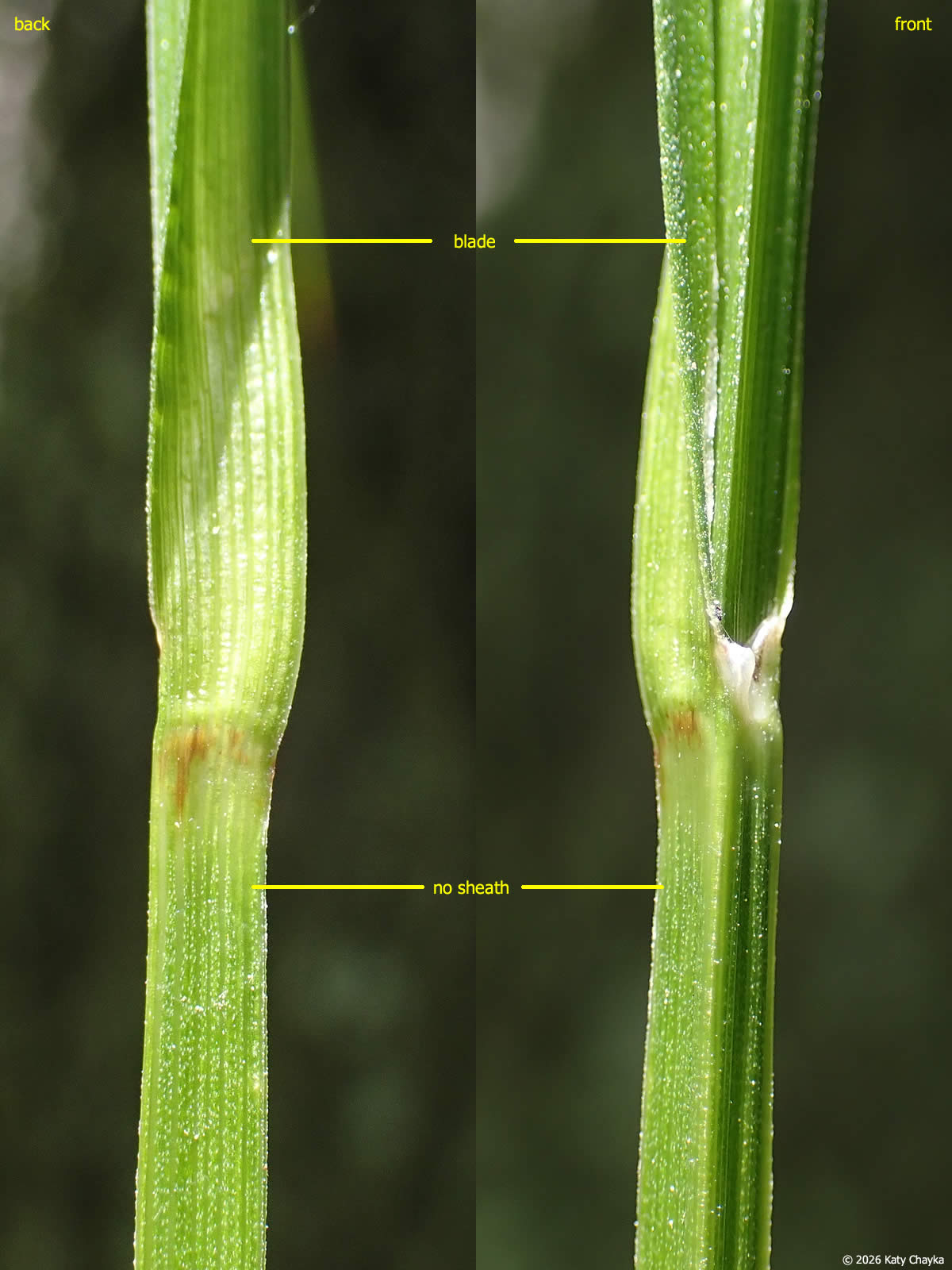 Pistillate spikes each have a leaf-like bract at the base of the stalk that is usually longer than the spike and may overtop the terminal spike. The bracts have little to no sheath.
Leaves and stems:
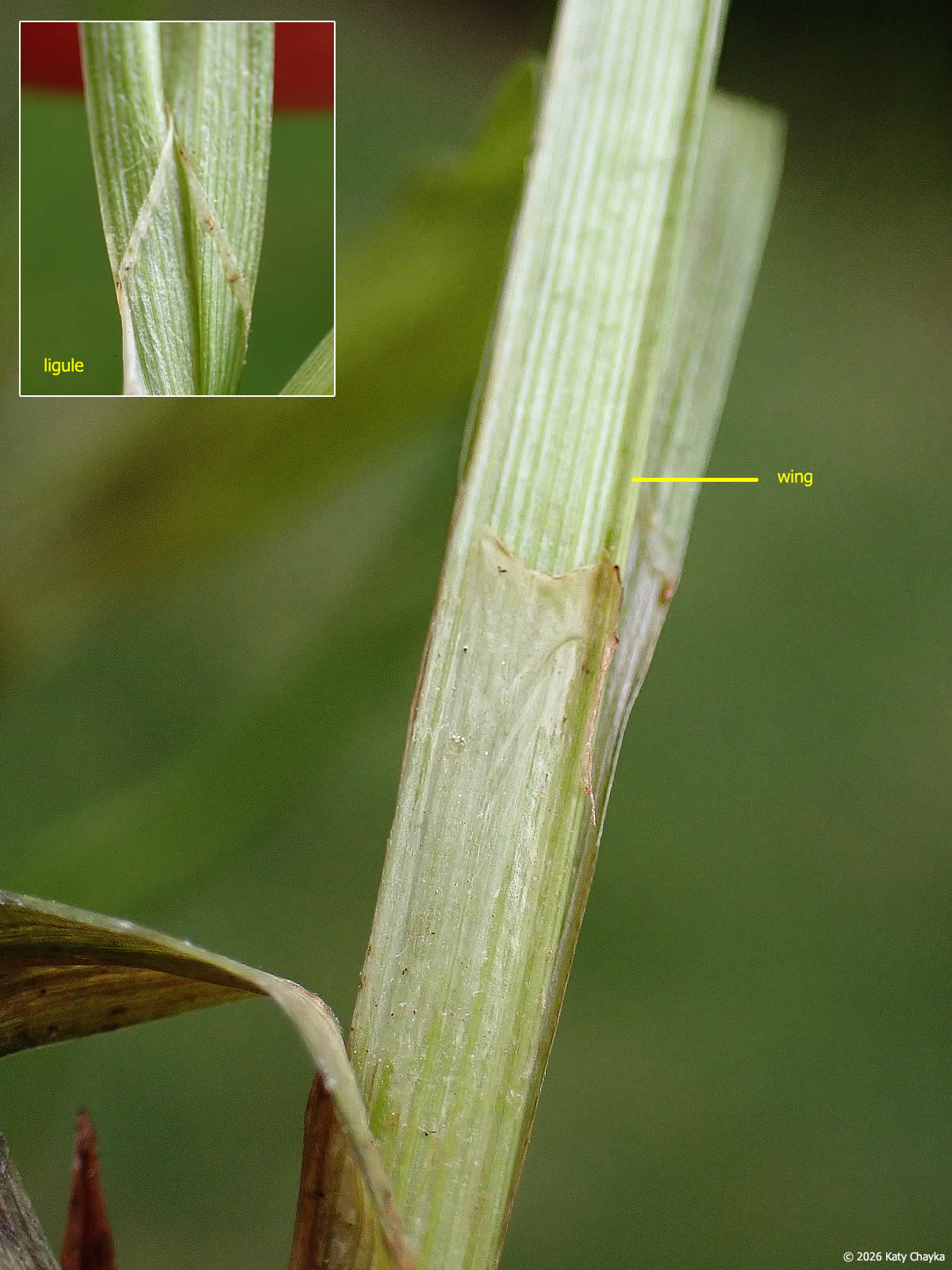 Leaves are basal and alternate on the lower stem, up to 16 inches (40 cm) long, longer or shorter than the flowering stems, hairless but rough-textured along the edges and the upper surface, flat or M-shaped in cross section. Leaves of sterile shoots are up to 18 mm (~¾ inch) wide and those of fertile stems 4 to 8 mm (to ~1/3 inch) wide. Leaf sheaths are hairless, thin, translucent whitish or yellowish, concave at the tip. The ligule (membrane where the leaf joins the sheath) is longer than wide.
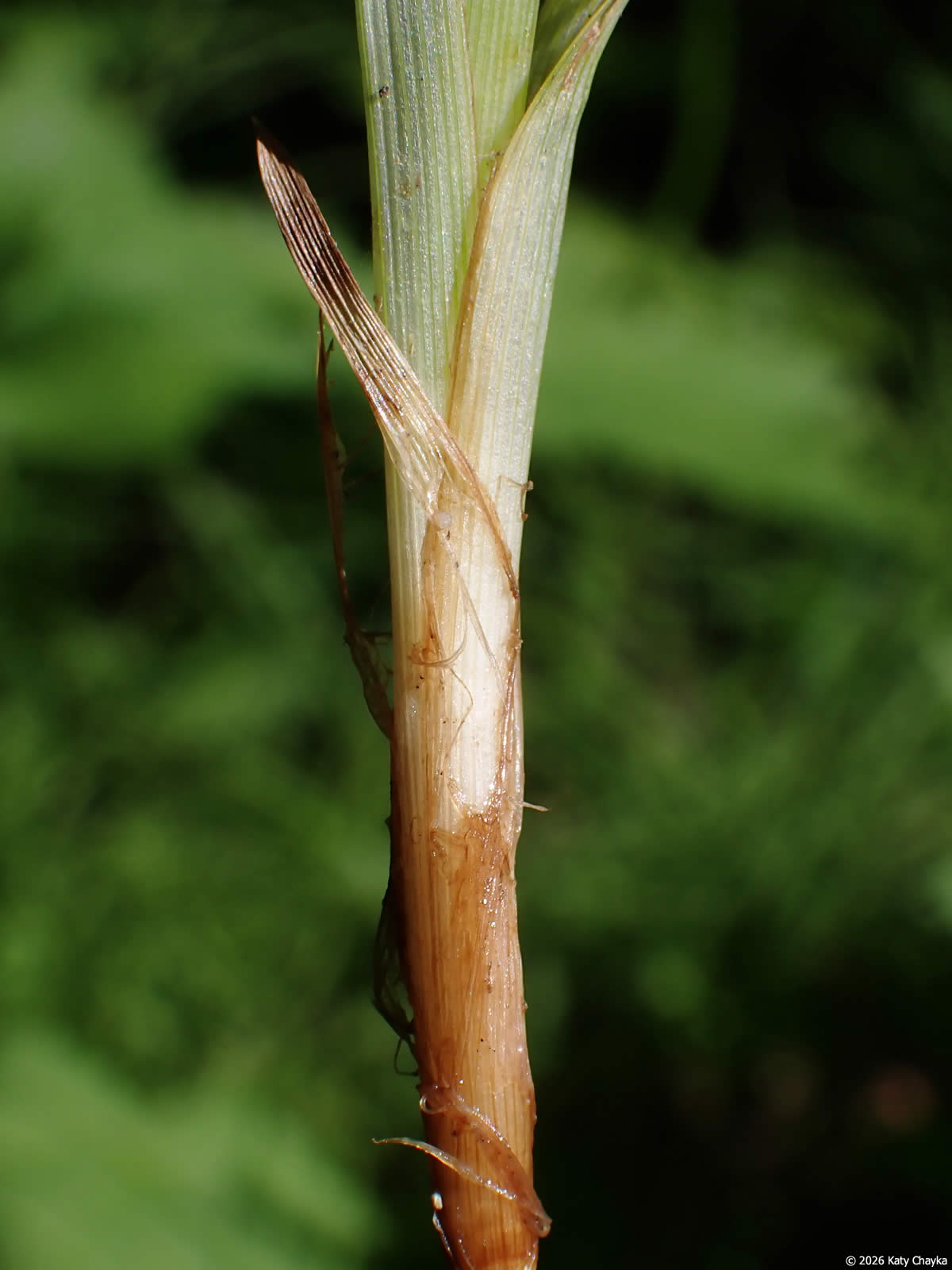 Bases are wrapped in a light brown sheath that is not fibrous. Stems are erect, stiff, 3-sided with a narrow wing or rib along the angles, hairless but rough below the spikes, and may elongate up to 30 inches at maturity. Plants form loose clumps and colonies from creeping rhizomes.
Fruit:
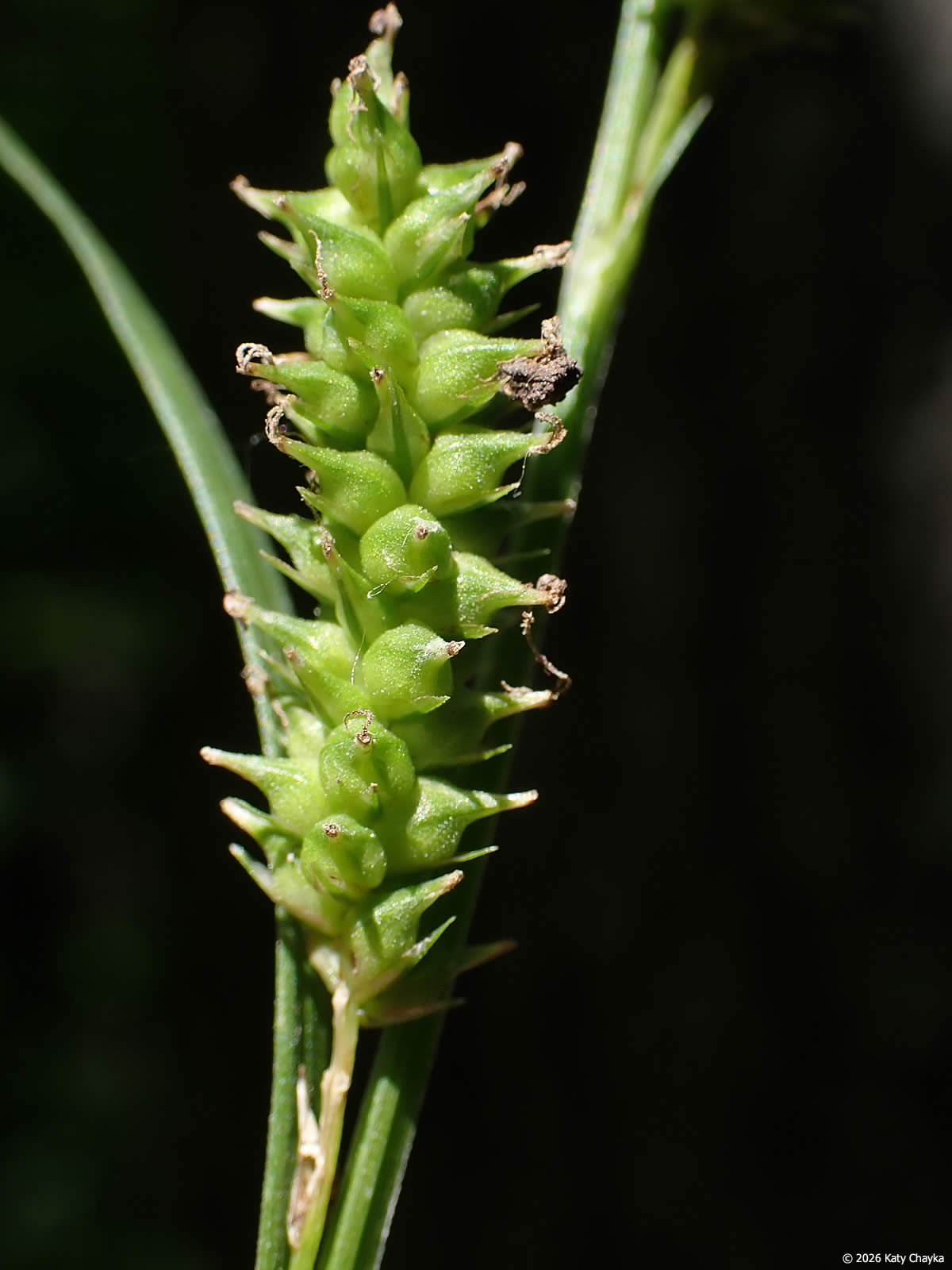 Fruit develops in late spring through summer and may persist until fall, the pistillate spikes forming clusters of seeds (achenes), each wrapped in a casing (perigynium), subtended by a scale. Pistillate spikes have 10 to 150+ fruits, the perigynia ascending to spreading and tightly packed.
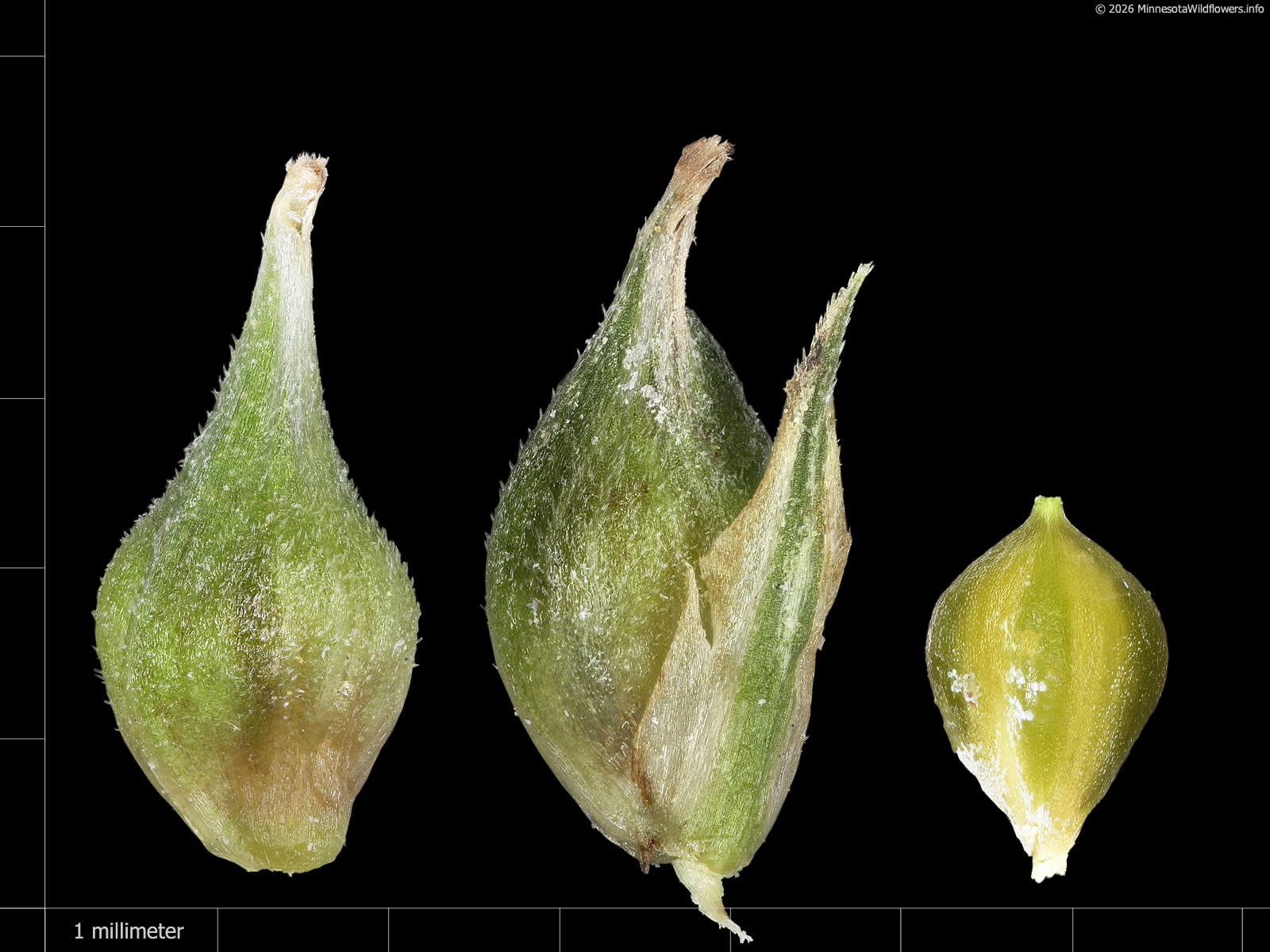 Pistillate scales
are usually brownish to reddish with a prominent green midrib, tapering to a pointed tip, sometimes the midrib extending to a short awn, fringed with short hairs especially at the tip, the scale nearly as long as the perigynia but angled to appear shorter.
Perigynia
are green drying brown at maturity, 2.5 to 4 mm long, 1.5 to 2 mm wide, prominently 2-ribbed with 6 to 8 veins (mostly obscure until dried), minutely hairy across the surface, nearly round in cross-section, abruptly tapering to a slightly bent beak that is nearly as long as the body, obscurely toothed and papery at the tip.
Achenes
are 1.5 to 2.3 mm long, strongly 3-sided, broadest at or above the middle, yellowish-brown at maturity.
Notes:
Carex scabrata is a new species in Minnesota, discovered in 2025 by Kelly Beaster in the Duluth area during a routine plant survey of a wet forest community with groundwater seepage. What really stood out was the robust perigynia still hanging on in pretty good shape in September, when most other sedges had shed theirs. It was not immediately known if this was an introduction, but a second population was found in the nearby remnant of a mesic forest that had been spared from clearing during development of a golf course. The DNR has since designated it native to the state. Its preferred habitat is wet deciduous woods, seepage slopes, creek borders, ravine bottoms and other wet spots in part shade, less often in clearings and swamps. Perhaps more populations are out there just waiting to be discovered.
Carex is a large genus, with over 600 species in North America and 150+ in Minnesota alone. They are grouped into sections, the species in each group having common traits. Carex scabrata is the lone member of the Anomalae section in Minnesota; some of its common traits are: clump and colony forming, basal sheaths brownish and not fibrous, leaves M-shaped in cross-section when young, 4 to 9 spikes, terminal spike all staminate or with a few perigynia, leaf-like bracts with little or no sheath, perigynia tightly crowded on the spike, ascending to spreading, prominently 2-ribbed, beaked, the beak papery at the tip, 3-sided achenes.
Carex scabrata is further distinguished by its narrowly winged stem, hairless leaves rough along the edges and upper surface, minutely hairy perigynia (magnification recommended) with 2 prominent ribs and 6 to 8 veins, though the veins may not be prominent until the perigynia dries down.
Carex scabrata superficially resembles some members of the Vesicariae and Ceratocystis sections; both of which lack winged stems and have hairless perigynia that are more obviously toothed and not papery at the tip. Vesicariae is more likely to have fibrous sheaths, and Ceratocystis is more likely to be shorter statured with short, stout spikes, and form clumps but not colonies.
Native Plant Nurseries, Restoration and Landscaping Services ↓
Map of native plant resources in the upper midwest


More photos
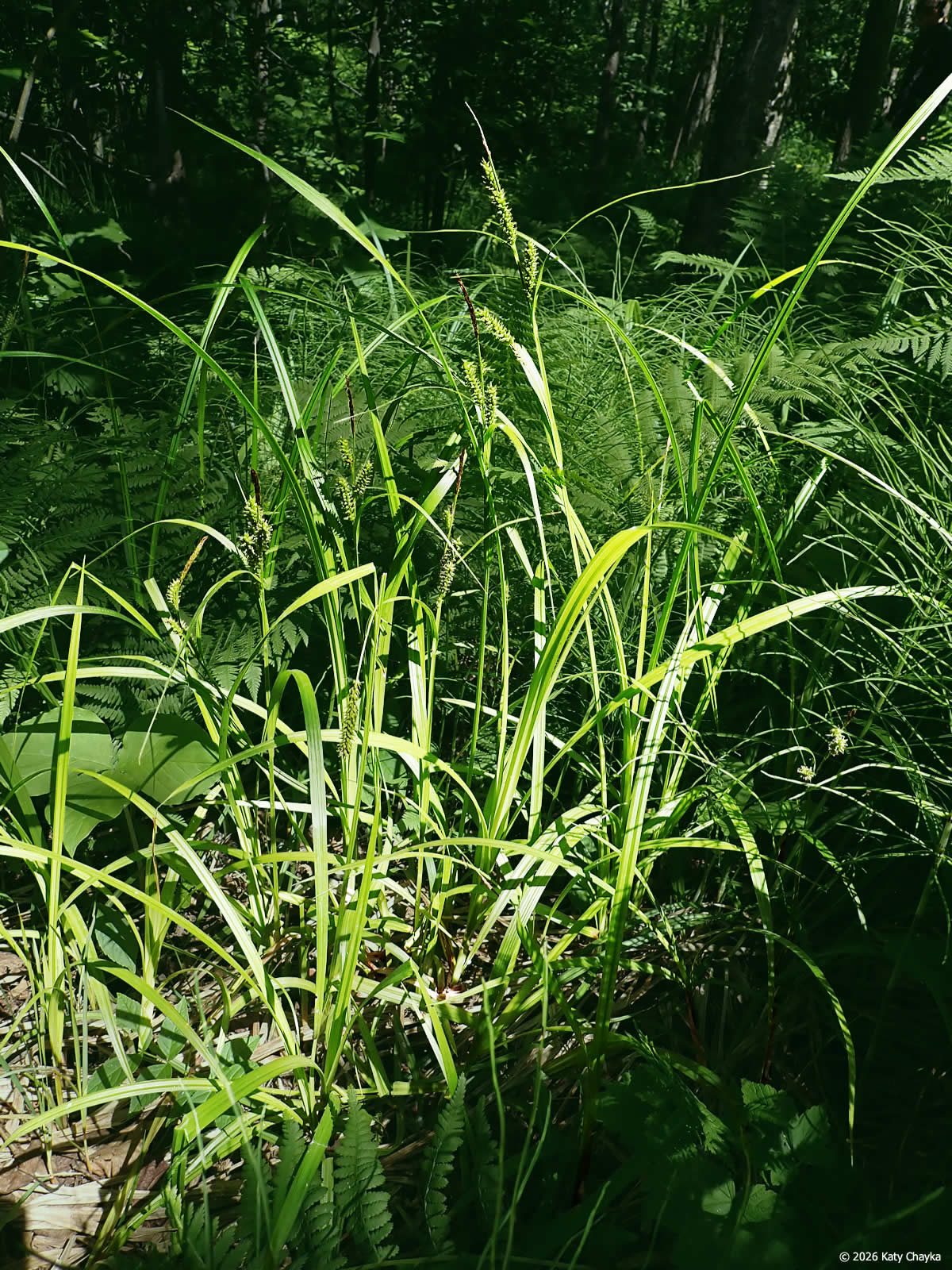 Carex scabrata plants
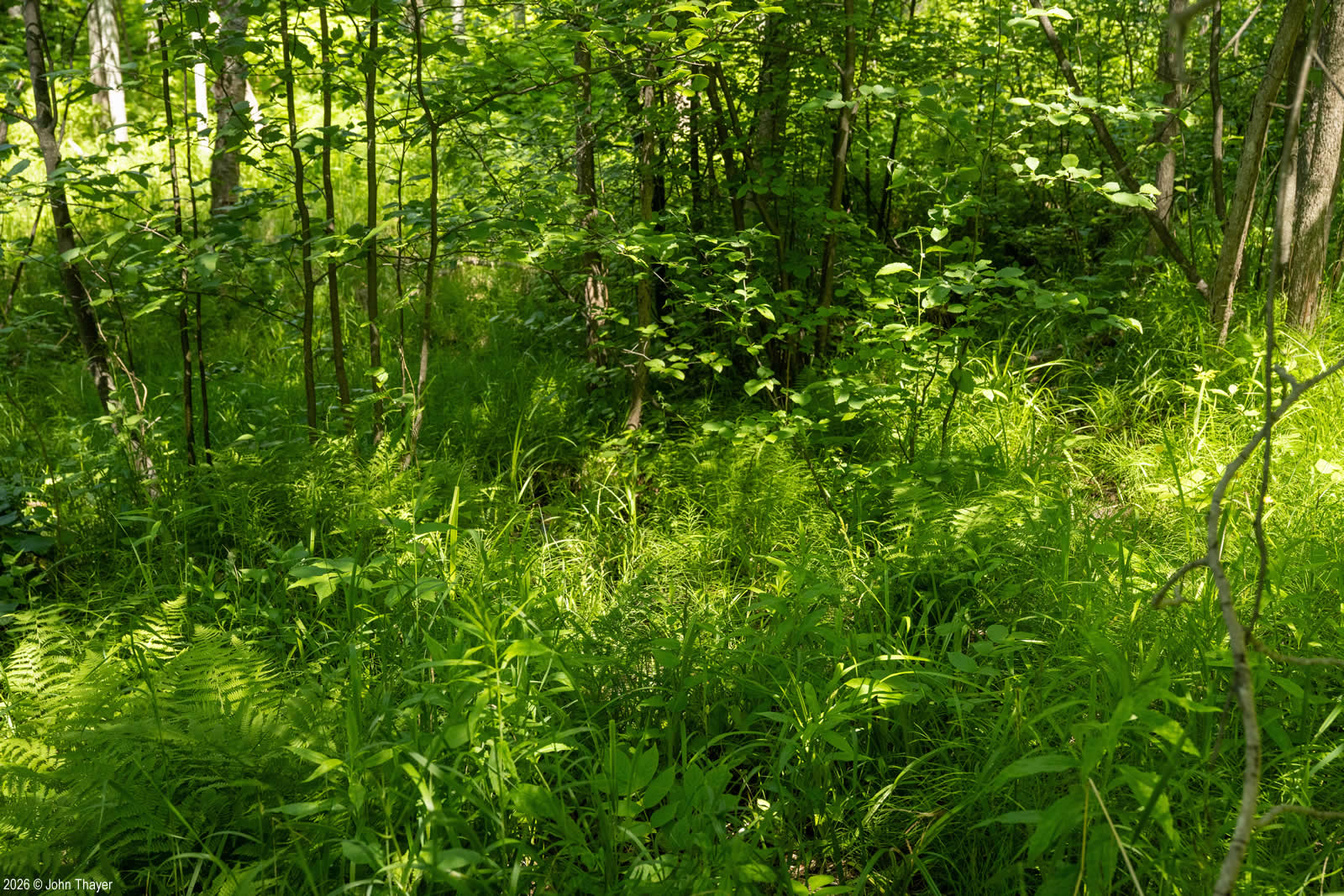 Carex scabrata habitat
Photos by Katy Chayka and John Thayer taken in St. Louis County.
Comments
Have you seen this plant in Minnesota, or have any other comments about it?