

Asclepias viridiflora (Green Milkweed)
| Also known as: | Green Comet Milkweed |
|---|---|
| Genus: | Asclepias |
| Family: | Apocynaceae (Dogbane) |
| Life cycle: | perennial |
| Origin: | native |
| Habitat: | sun; dry prairies, edges of woods, sandy soil |
| Bloom season: | June - August |
| Plant height: | 1 to 3 feet |
| Wetland Indicator Status: | none |
| MN county distribution (click map to enlarge): |  |
| National distribution (click map to enlarge): | 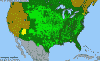 |
Pick an image for a larger view. See the glossary for icon descriptions.
Detailed Information
Flower: 
![[photo of flowers]](/udata/r9ndp23q/green/green-milkweed_0626_122403.jpg) Flowers are in a densely packed round cluster about 2 inches across arising from a leaf axil. Individual flowers are pale green, ¼ inch across and ½ inch long with a 5-parted crown and 5 petals that pull straight back away from the crown, sometimes flaring a bit. Sometimes there is a purplish tint to the flowers. Each plant has 1 to a few clusters.
Flowers are in a densely packed round cluster about 2 inches across arising from a leaf axil. Individual flowers are pale green, ¼ inch across and ½ inch long with a 5-parted crown and 5 petals that pull straight back away from the crown, sometimes flaring a bit. Sometimes there is a purplish tint to the flowers. Each plant has 1 to a few clusters.
Leaves and stem:
![[photo of linear leaves]](/udata/r9ndp23q/green/green-milkweed_0626_122620.jpg) Leaves are toothless, may have short hairs especially along the veins, are mostly opposite, though some may be alternate, and are very short stalked. Leaf shape is quite variable, from linear to lance-oblong. Linear leaves are often somewhat folded lengthwise, up to 6 inches long, less than 1 inch wide, smooth or somewhat wavy around the edges, straight or arching, usually pointed at the tip.
Leaves are toothless, may have short hairs especially along the veins, are mostly opposite, though some may be alternate, and are very short stalked. Leaf shape is quite variable, from linear to lance-oblong. Linear leaves are often somewhat folded lengthwise, up to 6 inches long, less than 1 inch wide, smooth or somewhat wavy around the edges, straight or arching, usually pointed at the tip.
![[photo of lance-oblong leaves]](/udata/r9ndp23q/pd/asclepias-viridiflora-29.jpg) Lance-oblong leaves are typically shorter, up to 2½ inches wide, often very wavy along the edges and usually pointed at the tip. Stems are covered in short matted hair and may be tinged purple. Plants may be erect but tend to lean over.
Lance-oblong leaves are typically shorter, up to 2½ inches wide, often very wavy along the edges and usually pointed at the tip. Stems are covered in short matted hair and may be tinged purple. Plants may be erect but tend to lean over.
Fruit:
![[photo of fruit]](/udata/r9ndp23q/green/green-milkweed_0717_105129.jpg) Fruit is a smooth, spindle-shaped pod about 3 inches long that contains numerous flat brown seeds with a tuft of white hair to carry it off in the wind.
Fruit is a smooth, spindle-shaped pod about 3 inches long that contains numerous flat brown seeds with a tuft of white hair to carry it off in the wind.
Notes:
Green Milkweed with linear leaves somewhat resembles the rare Narrow-leaf Milkweed (Asclepias stenophylla), which has even narrower leaves (¼ inch wide) and whiter flowers with more flaring petals, and also the rare Prairie Milkweed (Asclepias hirtella), which has stiffer, ascending leaves, and flowers have more flaring petals plus a distinct gap between the petals and crown. Plants with lance-oblong leaves somewhat resemble the rare Clasping Milkweed (Asclepias amplexicaulis), which has stalkless, clasping leaves and typically a single flower cluster at the top of the stem.
Native Plant Nurseries, Restoration and Landscaping Services ↓
Map of native plant resources in the upper midwest


More photos
 Green Milkweed plant
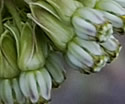 Green Milkweed with linear leaves
 Green Milkweed with lance-oblong leaves
 garden-grown Green Milkweed
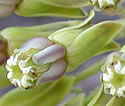 purple tinged flowers
 Green Milkweed plant
 Green Milkweed with linear leaves
 Green Milkweed with lance-oblong leaves
 garden-grown Green Milkweed
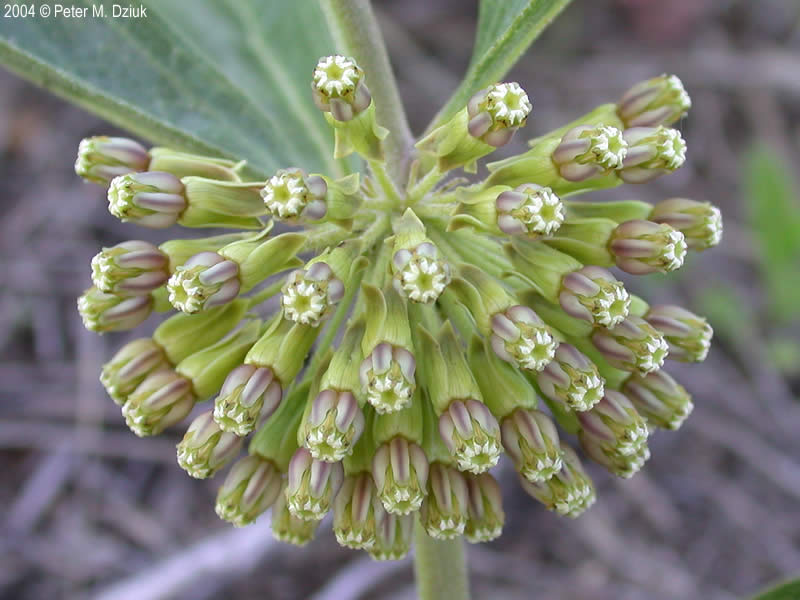 purple tinged flowers
Photos by K. Chayka taken at Wild River State Park, Chisago County. Photos by Peter M. Dziuk taken in Anoka and Big Stone counties.
Comments
Have you seen this plant in Minnesota, or have any other comments about it?
on: 2014-07-05 10:09:33
I found one of these July 4 on a west-facing blufftop in Ottawa Bluffs nature preserve, in bloom.
on: 2014-07-19 18:03:51
My first time seeing these today along the sandy east bank of the Mississippi River in Clear Lake SNA.
on: 2015-05-20 16:32:52
We have 38 acres of prairie that is registered with the state. Close to 30 years ago, I started documenting the plants with photos. I have photo documentation of green milkweed; if you would like me to e-mail my photos for confirmation, please let me know.
on: 2015-05-21 19:26:34
Rose, the best way to update county records is to submit a specimen to the University of MN Bell Herbarium, then it will be there for posterity. Anyone can submit a specimen, not just the DNR or other agency. The Bell has collecting guidelines on their website.
on: 2017-05-21 22:07:13
Iv'e found Green Milkweed on a bluff prairie on private land NE of Morris, overlooking the Pomme de Terre River.
on: 2021-07-03 13:45:36
We observed Asclepias viridiflora on the west-facing brow of Coyote Point, a bluff in Whitewater State Park on 7/1/2021.
on: 2022-08-23 15:53:14
Found some on a solar site in Chisago County near North Branch, very dry sandy soil along a white pine woods edge. Site also has blue-eyed grass, puccoon, and birdsfoot violet coming up (none of them in the seed mix)!