

Mentha arvensis (Wild Mint)
| Also known as: | Field Mint |
|---|---|
| Genus: | Mentha |
| Family: | Lamiaceae (Mint) |
| Life cycle: | perennial |
| Origin: | native |
| Habitat: | part shade, sun; moist soil; thickets, along shores, wet meadows |
| Bloom season: | July - September |
| Plant height: | 6 to 24 inches |
| Wetland Indicator Status: | GP: FACW MW: FACW NCNE: FACW |
| MN county distribution (click map to enlarge): |  |
| National distribution (click map to enlarge): | 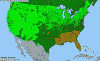 |
Pick an image for a larger view. See the glossary for icon descriptions.
Detailed Information
Flower: 
![[photo of flowers]](/udata/r9ndp23q/pd/mentha-arvensis-008.jpg) Clusters of about 20 flowers around the leaf axils along much of the plant, blooming from the bottom of the plant up. Individual flowers are about 1/8 inch long and tubular. The upper lip is notched into 2 parts, the lower lip has 3 lobes of equal size. 4 long stamens protrude from the tube. Flower color ranges from pink to pale lavender to white, with darker spots on the inside of the tube. The calyx is hairy with short, triangular lobes and is about a third as long as the flower.
Clusters of about 20 flowers around the leaf axils along much of the plant, blooming from the bottom of the plant up. Individual flowers are about 1/8 inch long and tubular. The upper lip is notched into 2 parts, the lower lip has 3 lobes of equal size. 4 long stamens protrude from the tube. Flower color ranges from pink to pale lavender to white, with darker spots on the inside of the tube. The calyx is hairy with short, triangular lobes and is about a third as long as the flower.
Leaves and stem:
![[photo of leaves]](/udata/r9ndp23q/pink/wild-mint-100_2182.jpg) Leaves are up to 2½ inches long and 1 inch wide, narrowly egg-shaped to elliptic, pointed at the tip, serrated around the edges, finely hairy on the underside, and have short stalks. Attachment is opposite, with pairs at right angles to those above and below it. Leaves are strongly aromatic when crushed. Stems are square, ascending to erect, green or sometimes red, and hairy, sometimes just along the angles.
Leaves are up to 2½ inches long and 1 inch wide, narrowly egg-shaped to elliptic, pointed at the tip, serrated around the edges, finely hairy on the underside, and have short stalks. Attachment is opposite, with pairs at right angles to those above and below it. Leaves are strongly aromatic when crushed. Stems are square, ascending to erect, green or sometimes red, and hairy, sometimes just along the angles.
Fruit:
Fruit is a set of 4 oval nutlets, each containing a single seed.
Notes:
Wild Mint has some similarities to Lycopus species, which also have opposite leaves, whorls of small flowers at the leaf nodes, and found in wet places. Lycopus flowers are white with only 2 stamens, however, and the leaves are not aromatic when crushed. There are apparently 2 varieties, with var. canadensis found in North America and var. arvensis native to Europe. According to the University of Michigan Herbarium, there is some evidence the North American species is derived from ancient hybridization of European Mentha species; they have accepted the name Mentha canadensis and dropped arvensis altogether Perhaps a name change will come to Minnesota, as well.
Native Plant Nurseries, Restoration and Landscaping Services ↓
Map of native plant resources in the upper midwest


More photos
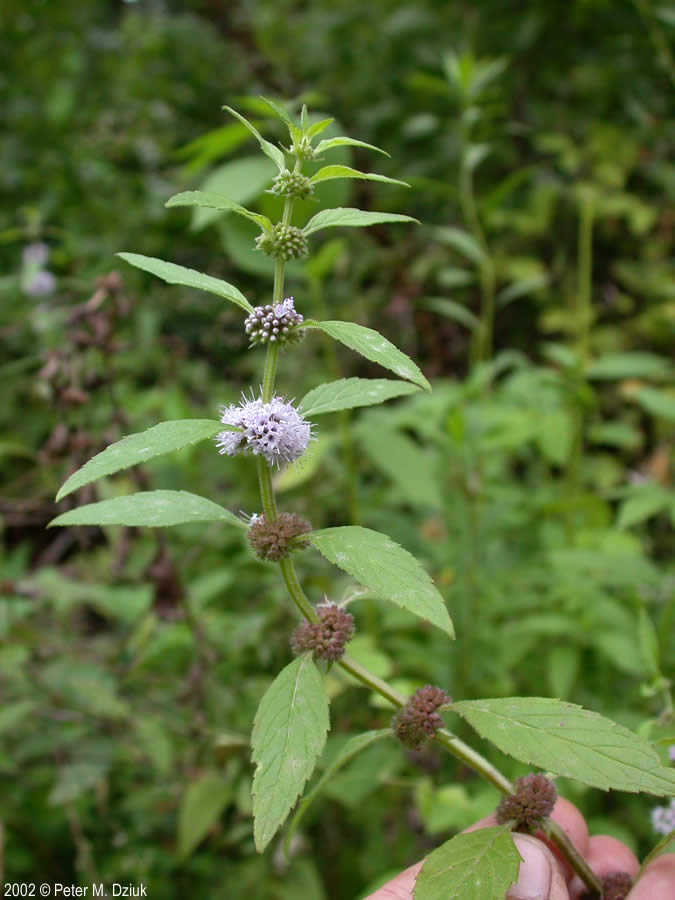 Wild Mint plant, with developing fruit
 an ambush bug waiting for a pollinator
 Wild Mint plants
Photos by K. Chayka taken at Long Lake Regional Park, Ramsey County. Other photos courtesy Peter M. Dziuk.
Comments
Have you seen this plant in Minnesota, or have any other comments about it?
on: 2008-08-14 12:08:15
Just identified our wild mint east of Brainerd, Thanks, can it be used like regular mint?
on: 2008-08-14 14:27:14
Yes, wild mint is edible, though it might be slightly bitter compared to what you'd get at the grocery store. BTW, I love walking through the stuff. The aroma of crushed wild mint leaves is potent, but loverly.
on: 2013-06-12 00:13:30
It grows like crazy here in Deer River next to our house, our barn, in our horse pasture, and all over the manure pile (good fertilizer, I suppose? haha) If we're not careful once in awhile it gets into our gardens and tries to take over! However, in the places where we do allow it to keep growing, it sure smells good, and it looks pretty when it flowers. Its also very handy for when we want to use for something -- my favorite uses for it are in summer drinks -- cucumber-mint flavored water, mojitos, and adding a little minty kick to lemonade or ice tea.
on: 2013-08-06 22:42:38
Found this lovely plant growing alongside a stream in my "backyard," which is literally William O'Brien State Park. It was in the company of Spotted Touch-Me-Not, and Forget-Me-Not's. I love how the flower "ball" grows in the center of the stem, and is comprised of tons of tiny flowers. I'd never seen this plant before - really pretty and a good "smeller!"
on: 2014-07-06 12:25:00
Poppped up alongside the large suburban drainage pond in front of our house. I have my "storebought" mint contained in large sunken pots in the garden so I was initially dismayed to find these escapees at the edge of the pond, but am pleased now to discover that they're native, have food uses, and smell nice. I've been working for years to develop an almost-all native yard. No turf grass. It's a Herculean task, particularly to keep fighting the invasives while I develop the garden. Thanks for a great website that provides information and inspiration!
on: 2014-08-06 09:47:18
one of three "strangers" I recently found near a slough at the edge of woods on our property. Also found--monkey flower, woundwort and blue vervain. Had never seen the first three before.
on: 2015-07-18 21:37:17
Grows on shoreline next to my dock
on: 2017-04-17 19:55:41
I found a plant that smells minty thats not it what do u think it is?
on: 2017-04-17 21:42:49
Sienna, there are many possibilities. Try the advanced search or post an image on our facebook page.
on: 2017-05-26 17:37:09
As far as I can tell, I found some growing in rocks along the edge of a lake. I was pulling up some weeds when something suddenly smelled minty and I had to look it up. Thanks for the info!
on: 2017-07-24 17:49:35
I found this plant along Falcon Drive near Lake Osakis.
on: 2017-08-12 22:48:35
I have a large quantity growing in my garden. I tried to get rid of it but soon realized it was not a winning battle. So, I control it non chemically and make tea leaves.
on: 2019-03-03 23:31:09
I've known about the abundant presence of this species in Carlton County since 1972. Makes a fine mint tea.