

Silene latifolia (White Campion)
| Also known as: | Bladder Campion, White Cockle |
|---|---|
| Genus: | Silene |
| Family: | Caryophyllaceae (Pink) |
| Life cycle: | annual, short-lived perennial |
| Origin: | Europe |
| Status: |
|
| Habitat: | shade, sun; disturbed soil, waste places, fields, edges of woods |
| Bloom season: | May - September |
| Plant height: | 18 to 48 inches |
| Wetland Indicator Status: | none |
| MN county distribution (click map to enlarge): |  |
| National distribution (click map to enlarge): | 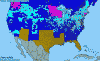 |
Pick an image for a larger view. See the glossary for icon descriptions.
Detailed Information
Flower: 
![[photo of female flower]](/udata/r9ndp23q/pd/silene-latifolia-68968-3.jpg) Raceme or open branched cluster of 1 to 1½ inch stalked white flowers. Flowers have 5 petals each deeply cleft into 2 broad lobes with a prominent fringe at the base of the petal forming a collar at the opening of the floral tube. Male and female flowers are on separate plants. Female flowers have 5 styles that elongate and curl out over the collar.
Raceme or open branched cluster of 1 to 1½ inch stalked white flowers. Flowers have 5 petals each deeply cleft into 2 broad lobes with a prominent fringe at the base of the petal forming a collar at the opening of the floral tube. Male and female flowers are on separate plants. Female flowers have 5 styles that elongate and curl out over the collar.
![[photo of male flower]](/udata/r9ndp23q/pd/silene-latifolia-68968-2.jpg) Male flowers have 10 pale yellow stamens that extend to or a little past the opening of the floral tube. The calyx behind the flower is densely hairy, inflated, larger and more urn shaped on female flowers, strongly veined and ridged, 10-veined on males and 20 on females, green or often deep maroon, especially on males. Flowers are odorous, open in the evening and close by noon, sometimes later on cloudy days.
Male flowers have 10 pale yellow stamens that extend to or a little past the opening of the floral tube. The calyx behind the flower is densely hairy, inflated, larger and more urn shaped on female flowers, strongly veined and ridged, 10-veined on males and 20 on females, green or often deep maroon, especially on males. Flowers are odorous, open in the evening and close by noon, sometimes later on cloudy days.
Leaves and stems:
![[photo of leaves]](/udata/r9ndp23q/white/white-campion_0619_180224.jpg) Leaves are 1¼ to 4 inches long, 1/3 to 1½ inches wide, lance-shaped to broadly elliptic, toothless, with short stalks on lower leaves becoming smaller and stalkless higher on the stem. Stems and leaves are hairy becoming glandular and sticky in the upper plant.
Leaves are 1¼ to 4 inches long, 1/3 to 1½ inches wide, lance-shaped to broadly elliptic, toothless, with short stalks on lower leaves becoming smaller and stalkless higher on the stem. Stems and leaves are hairy becoming glandular and sticky in the upper plant.
Fruit:
![[photo of fruit]](/udata/r9ndp23q/pd/silene-latifolia_4377.jpg) Fruit is an urn shaped capsule, about ½ inch long, turned up, the opening ringed with 10 upturned or spreading teeth, tan colored eventually turning dark brown. The capsule is covered in a brown papery wrapping that dries up and falls away when the capsule opens.
Fruit is an urn shaped capsule, about ½ inch long, turned up, the opening ringed with 10 upturned or spreading teeth, tan colored eventually turning dark brown. The capsule is covered in a brown papery wrapping that dries up and falls away when the capsule opens.
![[photo of seed]](/udata/r9ndp23q/pd/silene-latifolia-seed.jpg) Inside the capsule are numerous black seeds just over 1 millimeter long, somewhat kidney shaped and covered in a pattern of tiny pimples. A single female plant is capable of producing up to 24,000 seeds.
Inside the capsule are numerous black seeds just over 1 millimeter long, somewhat kidney shaped and covered in a pattern of tiny pimples. A single female plant is capable of producing up to 24,000 seeds.
Notes:
A widely distributed weedy species from Europe, White Campion is common in waste places and disturbed sites in both urban and rural areas. A very similar species is Night-flowering Campion (Silene noctiflora), which has slightly smaller perfect flowers (both male and female parts on the same flower) with only 3 styles, narrower petal lobes, and only 6 teeth on the opened capsule. Another species commonly called Bladder Campion is Silene vulgaris, which is mostly hairless overall with a smooth calyx and has long protruding stamens with purplish tips.
Native Plant Nurseries, Restoration and Landscaping Services ↓
Map of native plant resources in the upper midwest


More photos
 White Campion plants
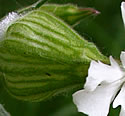 bloated female calyx
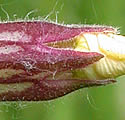 purple male calyx
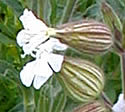 more plants, with Leafy Spurge and Yellow Sweet-clover
 White Campion plants
 bloated female calyx
 purple male calyx
 more plants, with Leafy Spurge and Yellow Sweet-clover
Photos by K. Chayka taken in Ramsey County. Photos courtesy Peter M. Dziuk taken in Anoka County.
Comments
Have you seen this plant in Minnesota, or have any other comments about it?
on: 2012-05-29 16:08:42
White Campion is blooming all around the roadsides here in late May.
on: 2012-05-29 22:52:07
This popped up all over my yard and garden this year.
on: 2014-07-02 15:51:26
Found growing along the trails.
on: 2014-07-12 15:12:58
Popped up all over my yard this year too! Its very pretty so I'm letting it stay.
on: 2014-08-11 18:49:05
Always see these along paths and not a fan of them, with all those seeds just sitting in that pod, how do they get so dispersed? Birds? I just cant see how it has spread so far.
on: 2015-10-05 22:22:37
Seen along trails in early October.
on: 2016-09-07 19:10:41
Had one pop up in my mailbox flower garden this year and have never seen any around out area before
on: 2017-06-07 09:00:41
Just popped up in my yard this year. They have many nice flowers, but I'll need to remove. There are too many seeds per pod and plant.
on: 2017-07-16 10:11:42
Growing in my backyard right now; I was going to pull it, but now that I know it's a wildflower, I may just transplant it to a different section to run wild.
on: 2017-07-16 12:49:33
Nathan, white campion is a non-native weed. There is enough of it running wild already.
on: 2018-01-31 07:36:59
My Honey Bees, along with other native bees, work this flower for nectar, pollen and water. The water part is the morning dew before the sun or wind has time to evaporate the water caught on the petals.
on: 2018-06-12 19:32:22
Found a male plant growing beside the mail box. I'll pull it and transplant some native wildflowers from my butterfly garden.
on: 2018-06-14 13:13:49
There appears to be plenty in bloom now (early June) in Rice Creek North Trail area in Ramsey County (NW Shoreview).
on: 2018-07-28 17:07:38
I've read the seed pod holds thousands of seed and they shoot open spreading seeds far and wide. pull these out!
on: 2020-06-22 10:07:25
Have seen it all along streambanks of Village Creek Pkwy. Private contractor was out pulling in mid-June.
on: 2023-05-30 22:16:02
Found growing near flower beds this year. We have been working with the soil last year & this year so, I am sure that made a nice resting spot for seeds to grow.
on: 2023-06-10 16:10:14
2nd time i have seen them in my yard. a couple of plants. ripping them out.