

Bidens tripartita (Three-lobed Beggarticks)
| Also known as: | Straw-stem Beggarticks, Leafy-bracted Beggarticks |
|---|---|
| Genus: | Bidens |
| Family: | Asteraceae (Aster) |
| Life cycle: | annual |
| Origin: | native |
| Habitat: | part shade, sun; along shores, wet ditches, wet fields, disturbed soil |
| Bloom season: | August - October |
| Plant height: | 6 to 60 inches |
| Wetland Indicator Status: | GP: FACW MW: OBL NCNE: FACW |
| MN county distribution (click map to enlarge): | 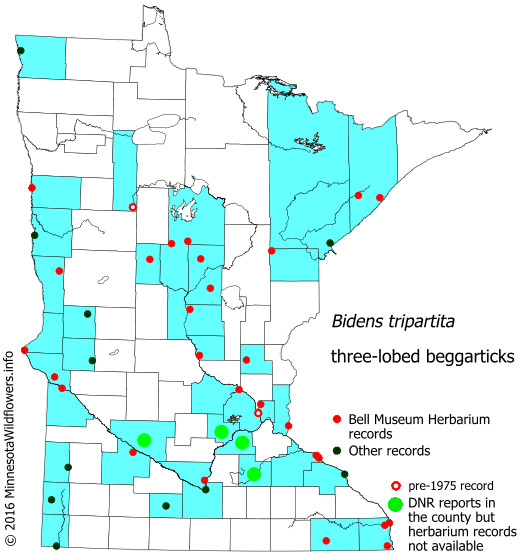 |
| National distribution (click map to enlarge): |  |
Pick an image for a larger view. See the glossary for icon descriptions.
Detailed Information
Flower: 
![[photo of flower]](/udata/r9ndp23q/yellow/three-lobe--beggarticks-100_5092.jpg) 1 to 3 stalked flower heads at the end of branching stems and arising from leaf axils. The flower center is broad, ½ to ¾ inch across, made up of tiny dull light yellow disk flowers with 4 or 5 lobes. Ray flowers (petals) are uncommon, though 1 to 5 rays, often short and stubby, may be observed. Inner bracts are relatively inconspicuous.
1 to 3 stalked flower heads at the end of branching stems and arising from leaf axils. The flower center is broad, ½ to ¾ inch across, made up of tiny dull light yellow disk flowers with 4 or 5 lobes. Ray flowers (petals) are uncommon, though 1 to 5 rays, often short and stubby, may be observed. Inner bracts are relatively inconspicuous.
![[photo of bracts]](/udata/r9ndp23q/pd/bidens-tripartita-79278-1.jpg) The head is surrounded, almost rosette-like, by 5 to 13 leafy outer bracts that are variable in size, ¼ to 2½ inches long, to 2/3 inch wide, broad lance-elliptic that are typically hairy near the base and may be sparsely hairy around the edges.
The head is surrounded, almost rosette-like, by 5 to 13 leafy outer bracts that are variable in size, ¼ to 2½ inches long, to 2/3 inch wide, broad lance-elliptic that are typically hairy near the base and may be sparsely hairy around the edges.
Leaves and stems:
![[photo of leaves]](/udata/r9ndp23q/pd/bidens-tripartita-79278-10.jpg) Leaves are 2 to 4 inches long, ¾ to 1½ inches wide, opposite, simple, narrow to broad lance-elliptic, usually toothed, sometimes untoothed, pointed at the tip, stalkess or tapering at the base to a (more or less) winged stalk. Occasionally a lower leaf may have one to a few lobes towards the base. Stems are erect and branched, green or yellow in color. Both stems and leaves usually smooth but may be finely hairy.
Leaves are 2 to 4 inches long, ¾ to 1½ inches wide, opposite, simple, narrow to broad lance-elliptic, usually toothed, sometimes untoothed, pointed at the tip, stalkess or tapering at the base to a (more or less) winged stalk. Occasionally a lower leaf may have one to a few lobes towards the base. Stems are erect and branched, green or yellow in color. Both stems and leaves usually smooth but may be finely hairy.
Fruit:
![[photo of fruit]](/udata/r9ndp23q/yellow/three-lobe-beggarticks_1008_164814.jpg) Flower heads turn into round seed heads, covered in flat, dark brown seeds.
Flower heads turn into round seed heads, covered in flat, dark brown seeds.
![[photo of seed]](/udata/r9ndp23q/pd/bidens-tripartita-seed-2.jpg) Seeds are 1/3 to ½ inch long, usually with 3 barbed awns, the middle awn shorter than the side awns.
Seeds are 1/3 to ½ inch long, usually with 3 barbed awns, the middle awn shorter than the side awns.
Notes:
Three-lobe Beggarticks often goes by Latin name Bidens comosa but the accepted name in Minnesota is Bidens tripartita. There are several species of Bidens with similar flowers, but they are not so difficult to tell apart once you know the secret. Purple-stem Beggarticks (Bidens connata) also has opposite leaves that are mostly simple, but a smaller flower head that is more orange than yellow, narrower leafy bracts, and 4-angled seeds that usually have 2 to 4 awns. Devil's Beggarticks (Bidens frondosa) has leaves compound in 3s or 5s and seed with only 2 awns. Big Devil's Beggarticks (Bidens vulgata) has numerous bracts that are densely and coarsely hairy, leaves compound in 3s or 5s, and 2-awned seeds. While several references state Three-lobe Beggarticks can reach heights of 5 feet, I have not personally seen it more than 2 feet tall.
Native Plant Nurseries, Restoration and Landscaping Services ↓
Map of native plant resources in the upper midwest


More photos
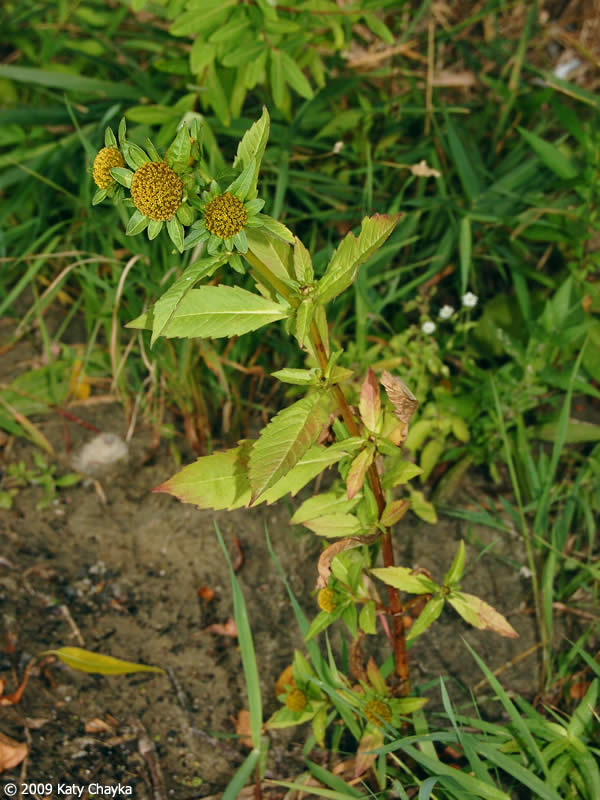 Three-lobed Beggarticks plant
 more plants
Photos by K. Chayka taken at Long Lake Regional Park, Ramsey County, and Coon Rapids Dam Regional Park, Anoka County. Photos courtesy Peter M. Dziuk taken in Ramsey County.
Comments
Have you seen this plant in Minnesota, or have any other comments about it?
on: 2015-09-11 22:45:34
I have also seen it in Cold Spring, MN, by small creeks and wetland.
on: 2018-08-21 20:21:51
This plant appeared on our farm prolifically this summer, the first time I have ever noticed it. A friend's daughter had it spring up in her Mpls yard this summer, too, and we were worried it might be an invasive that came in with our birdseed. Relieved to learn it is native.
on: 2023-09-02 15:21:01
Sowed itself into, and sprouted from, winter sowing containers of other native species. ID'ed only after the trilobed seeds appeared (and leaped onto our clothes!)