

Dalea villosa (Silky Prairie Clover)
| Also known as: | Downy Prairie Clover |
|---|---|
| Genus: | Dalea |
| Family: | Fabaceae (Pea) |
| Life cycle: | perennial |
| Origin: | native |
| Habitat: | sun; dry; sandy soil, prairies |
| Bloom season: | July - August |
| Plant height: | 12 to 18 inches |
| Wetland Indicator Status: | none |
| MN county distribution (click map to enlarge): |  |
| National distribution (click map to enlarge): | 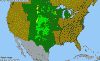 |
Pick an image for a larger view. See the glossary for icon descriptions.
Detailed Information
Flower: 
![[photo of flowers]](/udata/r9ndp23q/pink/dalea-villosa-silky-prairie-clover-0721_073330.jpg) A tightly packed cylindrical spike, 1 to 5 inches long, of tiny flowers with long pale yellow-tipped stamens, blooming from the bottom of the spike up. Flower color ranges from lavender to pink, and is sometimes white. The calyx behind the flower is light gray and woolly, most easily seen in the upper spike where flowers have not yet bloomed. A plant has a few to several spikes, which may be straight and erect but more often curved or bent.
A tightly packed cylindrical spike, 1 to 5 inches long, of tiny flowers with long pale yellow-tipped stamens, blooming from the bottom of the spike up. Flower color ranges from lavender to pink, and is sometimes white. The calyx behind the flower is light gray and woolly, most easily seen in the upper spike where flowers have not yet bloomed. A plant has a few to several spikes, which may be straight and erect but more often curved or bent.
Leaves and stem:
![[photo of leaves and stem]](/udata/r9ndp23q/pink/dalea-villosa-silky-prairie-clover_0701_101428.jpg) Leaves are about 1 inch long and compound with up to 21 narrow leaflets, each about ¼ inch long. Leaflets are covered in fine tan hairs, giving the leaves a grayish hue. Stems are also densely covered in fine hairs, often pinkish, may be multiple from the base and branching in the upper plant.
Leaves are about 1 inch long and compound with up to 21 narrow leaflets, each about ¼ inch long. Leaflets are covered in fine tan hairs, giving the leaves a grayish hue. Stems are also densely covered in fine hairs, often pinkish, may be multiple from the base and branching in the upper plant.
Fruit:
![[photo of fruit]](/udata/r9ndp23q/pink/dalea-villosa-silky-prairie-clover_0825_181613.jpg) Fruit is a tiny pod about 1/8 inch long, densely covered in woolly hairs and containing smooth brown seeds.
Fruit is a tiny pod about 1/8 inch long, densely covered in woolly hairs and containing smooth brown seeds.
Notes:
Silky Prairie Clover is similar to Lead Plant (Amorpha canescens); both grow in clumps in the same type of habitat, have long spikes with protruding stamens and hairy compound leaves. Lead Plant is generally a larger plant, however, with larger leaves, its flowers are more blue-violet in color, and the stem is woody and hairless. It also blooms earlier. Silky Prairie Clover comes in when Lead Plant goes out.
Native Plant Nurseries, Restoration and Landscaping Services ↓
Map of native plant resources in the upper midwest


More photos
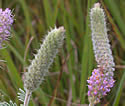 Silky Prairie Clover plant
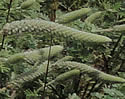 Silky Prairie Clover habitat
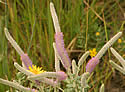 more plants
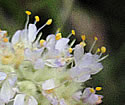 white Silky Prairie Clover flowers
 Silky Prairie Clover plant
 Silky Prairie Clover habitat
 more plants
 white Silky Prairie Clover flowers
Photos by K. Chayka taken at Long Lake Regional Park, Ramsey County. Other photos courtesy Peter M. Dziuk.
Comments
Have you seen this plant in Minnesota, or have any other comments about it?
on: 2012-07-22 14:49:52
In bloom now at Grey Cloud Dunes SNA.
on: 2013-08-13 17:11:41
Seen on Sunday, August 11, 2013 in Kellogg Weaver Dunes SNA.
on: 2016-07-24 21:12:14
I have never seen this plant before along our walking trail in the nine years I have walked here, but today I discovered a blooming group of plants. The flower is a deeper purple than in the pictures on this website and it has orange accents.
on: 2016-07-25 07:51:49
Kathy, what you found sounds like an Amorpha species, though neither they nor silky prairie clover should be naturally occurring in St. Louis County.
on: 2017-07-25 10:03:13
Just starting to bloom now. Growing well in VERY sandy soils.
on: 2018-07-07 00:43:31
I saw a number of these silky prairie clover plants in the Fertile Sand Hills today (just west of Fertile, MN). I posted a photo to Facebook and someone identified it for me. Lots of lead plant blooming in the Fertile Sand Hills right now also. Purple prairie clover, harebells, some remaining spiderwort, and lots more in bloom. Rough blazing star buds getting ready to bloom. LOTS of poison ivy--I was mowing trails to make it easier for public to enjoy Sand Hills with less poison ivy.
on: 2018-07-21 21:01:42
Encountered a large population of silky prairie clover in dry prairie in the Helen Allison SNA. Pretty cool as I've never seen this plant before. Seen a multitude of other plants. Will return to the SNA within the next week to see the next round of bloomers.
on: 2018-08-05 15:26:49
Not sure why but there is a bumber crop flowering at Uncas Dunes right now. Very popular with insects, particularly Bumble Bees.
on: 2018-08-08 12:57:44
We have about an acre of it. Covered with pollinatores, mainly bumble bees.
on: 2018-08-24 20:13:16
Found flowering in drier, open patches of the dunes.
on: 2019-07-27 21:07:55
First time seeing this in my area. Behind Costco parking lot in Baxter is quite a few plants. Lovely!
on: 2020-08-03 22:49:21
8/1/20 Lots of it blooming on the prairie near the main classroom building at Belwin which is normally not open to the public but is now open on Saturdays, I think through September.
on: 2021-06-24 07:40:31
I am very familiar with Lead Plant...is it possible to have Silky Clover here...how do you tell the difference between young Lead Plant, and mature Silky Clover
on: 2021-06-24 08:41:39
Kenny, check the stems: woody and hairless or herbaceous and hairy.
on: 2023-04-29 19:37:01
I'd like to convert part of my lawn to a native clover. Where would I find seed to spread?
on: 2023-04-30 05:40:32
Kim, Minnesota Wildflowers does not track who sells what, so check with native plant nurseries, many of which sell seed and plants via mail order.
on: 2023-07-06 19:29:48
I have been seeing BEAUTIFUL Silky Prairie Clover in the Sherburne Wildlife Refuge!!