

Scilla siberica (Siberian Squill)
| Also known as: | |
|---|---|
| Genus: | Scilla |
| Family: | Liliaceae (Lily) |
| Life cycle: | perennial |
| Origin: | Eurasia |
| Status: |
|
| Habitat: | part shade, sun; moist soil; open woods, roadsides, gardens |
| Bloom season: | March - May |
| Plant height: | 3 to 6 inches |
| Wetland Indicator Status: | none |
| MN county distribution (click map to enlarge): | 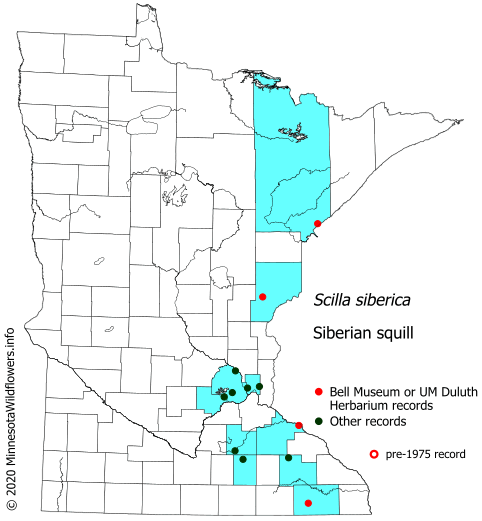 |
| National distribution (click map to enlarge): |  |
Pick an image for a larger view. See the glossary for icon descriptions.
Detailed Information
Flower: 
![[photo of flower]](/udata/r9ndp23q/pd/scilla-siberica-5829-1.jpg) Flowers are single, or in a raceme of 2 or 3 flowers at the top of a slender naked stem. Each flower is about 1 inch across when fully open, has 6 flaring blue petals with a darker blue stripe down the center and 6 white stamens with dark blue tips. The flowers are somewhat bell-shaped when not fully open. Other cultivars of this species may have white, pink or blue-violet flowers.
Flowers are single, or in a raceme of 2 or 3 flowers at the top of a slender naked stem. Each flower is about 1 inch across when fully open, has 6 flaring blue petals with a darker blue stripe down the center and 6 white stamens with dark blue tips. The flowers are somewhat bell-shaped when not fully open. Other cultivars of this species may have white, pink or blue-violet flowers.
Leaves and stem:
![[photo of leaves]](/udata/r9ndp23q/blue/siberian-squill_0501_104952.jpg) Leaves are basal and grass-like, to 5 inches long and ¼ to ½ inch wide. Leaves and stems are hairless. A plant may have several flowering stems.
Leaves are basal and grass-like, to 5 inches long and ¼ to ½ inch wide. Leaves and stems are hairless. A plant may have several flowering stems.
Notes:
This is a classic case of gardening gone awry. Siberian Squill was brought to this country as an ornamental and is still sold in Minnesota and elsewhere, but it has also escaped into the wild and become invasive. It readily spreads itself and is difficult to get rid of, as broken roots often resprout. It is very hardy and cold tolerant, and is left untouched by critters from voles to deer. Sadly, the same traits that make it attractive as a garden plant (besides the vivid color) are also what make it invasive. Large colonies of squill can be seen in the eastern counties of the state, from Duluth to Rochester. There is even an infestation at the University of Minnesota St Paul campus, just a block away from the Bell Herbarium. It is currently unknown how far west its range has expanded (the county distribution map at USDA Plants is quite outdated). Found in the wild, this species has been mistaken for harebell and blue-eyed grass, both native species.
Please, all you gardeners out there: stop planting this. Spring blooming native species with blue flowers you might plant instead are Hepatica (Hepatica nobilis), bluebells (Mertensia virginica or M. paniculata), blue phlox (Phlox divaricata) or any number of native violets. Harebell (Campanula rotundifolia) could provide bell-shaped blue flowers for the rest of the season.
Native Plant Nurseries, Restoration and Landscaping Services ↓
Map of native plant resources in the upper midwest


More photos
 Siberian Squill plants, garden grown
 an infestation of Siberian Squill
 flowers not fully open
Photos by K. Chayka taken at Coon Rapids Dam Regional Park, Coon Rapids, MN, May 2008. Photo courtesy Dan Ondler taken in Oronoco, MN. Photos courtesy Peter M. Dziuk taken in a private garden in Lino Lakes, MN.
Comments
Have you seen this plant in Minnesota, or have any other comments about it?
on: 2010-04-15 23:20:40
For as long as I've been involved in the discussion, gardeners and other foreign plant dealers have insisted that very few of the plant species they introduce to "improve" our environment actually turn out to be invasive. The example often given is the spring flowering bulbs from the Netherlands. I disagree. If it is hardy here and can produce propagules, it will always - sooner or later - invade native habitat, just as Siberian Squill is proving now. I saw it first in the "wild", many years ago now, running up and down the Grindstone River just outside of Hinckley. Anita Cholewa at the Bell Herbarium told me it was being reported all over the state. It is as bad if not worse than garlic mustard - you can't even pull this crap.
Which gardeners are now willing to stand up and take responsibility, or is this just another "so sorry"? Gardeners, this is stupid... mindless... enough!
on: 2011-04-16 09:01:34
Finally, after 40 years of living in the same house, I have identified the little blue flowers that blossom with the snow on the ground. Early Siberian Squill. They grow wild along the front of my house. I find them to be quite beautiful. I find nothing offensive about them. A whole lot prettier than dandilions, which I wish were gone, gone, gone. So all you gardeners out there, bite me. My Squill will be left in peace, while I continue to fight a war on the big 'D'.
on: 2011-04-19 10:54:59
Thank you for helping me to identify this plant. It is growing like a carpet in places in the dog park in the Lake Minnewashta Park.
on: 2011-04-28 08:55:22
Found it growing in the stand of evergreens on the east side of the SMSU nature walk. There are both white and blue varieties with the white seeming to be more vigorous. It is not a very big area so far. I was excited to find this pretty little flower and now I learn it is another invasive plant.
on: 2011-05-11 10:47:59
Mmm, invasive yes, but considering the fact that Scilla goes completely dormant in late spring, I'm not sure how much it is actually hurting other plants that are just beginning to sprout at that time.
on: 2011-05-11 13:33:37
Considering that Scilla has crowded out the early natives, such as bloodroot, hepatica, and other woodland species, I can't say that it is NOT hurting other plants. Native insects depend on those early natives as a food source that Scilla cannot provide. It's a lost ecosystem.
on: 2012-03-24 16:52:59
Chayka, can you prove definitively that bloodroot, hepatica "and other woodland species" are losing out to squill, or is it something else? I'll bet there's no proof.
on: 2012-03-24 17:02:15
...are black walnut trees taking over woodlands where bloodroot, heptaicas, and "other woodland species" grew? And are there other trees besides black walnut that stunt the growth of nearly everything under them, or kill?
on: 2012-03-24 22:22:18
My husband stopped in Dresbach today and took some pictures with our girls laying in this. Love it!
on: 2012-03-25 06:35:07
@1001ntt, I think the onus is not on me defending natives, but on those who defend the introduction of alien plants to a local ecosystem which has evolved over millennia to co-exist with black walnut trees and other native species. What does something like Scilla give to the habitat in which it invades? Anything that is strictly "beneficial" to human life, including mere aesthetics, does not count. The ecosystem must support the natural wildlife that has inhabited the location for hundreds or thousands of years. So what does Scilla (or any other alien species) contribute that natives cannot?
on: 2012-03-25 08:44:04
I have a pretty thick crop of these growing behind my house. I'm assuming the previous owner of my house must have bought and planted them since they have completely taken over a bedded in area, but they are also venturing out into the lawn.
on: 2012-03-25 21:56:53
My husbad and I were riding bikes when I saw this striking blue under the trees. It almost looked like water. Had no idea they were invasive but they sure caught our eyes.
on: 2012-03-31 15:03:48
I've never seen these flowers in the lawn before this year. Some are white with blue stripes on each petal, some are violet with blue stamens. I don't know if they are different forms (or stages) of the Siberian Squill, but the photos look similar to what is posted. I thought at first they were bluebells. I found a dense stand of them about 30 feet away under the neighbor's crabapple tree; they may have been planted there previously.
on: 2012-03-31 16:08:28
Sue, the white flowers with blue stripes is a different but related species: striped squill, Puschkinia scilloides. It also escapes cultivation but I don't think it's as aggressive as its blue cousin
on: 2012-04-02 16:59:48
I'm sad to read this is invasive. I noticed a few of these in my wooded back yard last year. This year there are about 10 times more. They are pretty. i was delighted to find them until I found this article.
on: 2012-04-09 21:01:08
This plant has been one of my favorites since I dug some out of my grandmother's garden in St Paul, where it was taking over. I will look for a replacement. I have a farm in Wright County where I am going to try to restore native plants and woods. I'm glad to have found this website.
on: 2012-04-20 15:51:56
Chayka is right. Pretty though these may be, they are the Twinkies of the field. They have no "nutritional" value to our local fauna. They clearly spread quickly and form agressive colonies which will obviously crowd out what was there before (natives).
on: 2012-06-05 09:51:42
30 years ago I planted 25 of these bulbs in my back yard wooded area. They have now grown to an area about 5 feet square. In thirty years. They come up, bloom and die back in about 3 weeks time. After they are gone other plants grow in that area. I also planted a few dozen of them in several places in my front lawn where they have not spread and are very spindly. Again, they don't seem to affect the later plants. I believe your definition of INVASIVE (as given on your home page) is very broad; remember: all plants are biologically programmed to reproduce themselves and spread. Just because a plant spreads and is not native does not make it invasive.
on: 2012-06-05 10:00:51
Cindy, we admit our definition of invasive is broad and make no apologies for it. I think you should also recognize that just because squill seems to have behaved itself in your own yard does not make it generally a non-pest plant. If it's spindly perhaps your soil conditions aren't right for it to flourish. Regardless, there are more accounts of it being a problem than not. Just take a look at the photo (above) of the infestation in Oronoco, MN to see what it can do. That is a problem, don't you think?
on: 2012-09-30 22:34:20
These flowers are not merely nonnative ornamentals. They do provide (gorgeous blue!) pollen to native bees as well as honeybees foraging in early spring. They are also recommended for planting in the book "Attracting Native Pollinators" by Eric Mader, et al.
on: 2013-04-22 16:57:16
Im not from Minnesota and perhaps i dont have a say in your discussion. But just an FYI: this pretty little flower that you call invasive is actually endangered in Russia and it is officially forbidden to pick it in the woods. It is the first sign of spring, a gorgeous one. We have lots of other plants and flowers that flourish in the same area without being affected. But blue Scilla is definitely people's favorite. Our forests are blue in spring and colorful in summer. But unfortunately people still do pick them. They smell great and every time I was taking pics of them there were bees flying around. And I'm sure those know what they are doing. The bottom line - invasive and useless - I doubt it. But everyone has a right for a different opinion.
on: 2013-04-23 07:44:34
Dear Inna,
I understand that Scilla is prized in your part of the world, but that is where it evolved so it belongs there. It is a natural part of your ecosystem and has been for thousands of years.
The same is not true here. We have our own native plant species that evolved with our native insects that belong in our unique ecosystems, and those are the species that should be in our woodlands. Over here, the natural predators that keep Scilla populations under control do not exist, so it is free to spread wherever it finds suitable habitat. I know someone who saw Scilla take over an entire woodlands in a matter of 5 years. It replaces our own native species when it does that and degrades the ecosystem for insects that depend on our natives.
Danielle, I have learned that some bees do feed on Scilla, but that does not make it a viable replacement for the natives it displaces. Some generalist insects can make use of it or other exotics as a food source, but specialist insects suffer when the diverse native plant populations are reduced or wiped out. I contacted the Xerces Society about their recommended plant lists and expressed concerns about some that are generally available in the garden trade but known to escape cultivation and invade natural areas. While they do prefer people plant native species, they don't discourage exotics or have a policy on invasive species, which is counter-productive. That's really unfortunate because the organization otherwise does good work.
Anyone who doesn't understand the special relationships between insects and plants should read Doug Tallamy's book "Bringing Nature Home". It should be required reading for all gardeners, everywhere. An educated gardener is our best hope for preventing the further collapse of native insect populations (bees, butterflies and everything else, and on up the food chain), and the ecosystems they need to survive.
on: 2013-04-29 17:21:35
This was apparently planted by former owners of our home. It has been very invasive in our yard. I am trying to restore the woods in our backyard to a native environment, and it just sickens me to see the squill spreading throughout the woods, not to mention planted areas and our lawn. Every year more and larger swaths of the plant appear in the woods, this despite countless hours spent pulling the foliage and blooms before it goes to seed. From what I've read on the web, that's about all one can do.
on: 2014-04-24 22:25:45
We found individual plants in two separate locations. We did not know it was invasive, we will destroy it if we see it again.
on: 2014-04-26 18:32:17
I must have planted 1. Now there are thousands. I am wondering if their bulbs will eventually push trilliums & every other plant out of the ground by the sheer volume of their bulbs. Boy do I regret planting this!
on: 2014-05-03 15:06:19
How does one go about eradicating Siberian squill?
on: 2014-05-03 16:54:32
It is very difficult to eradicate. It does not respond to herbicides like broad-leaf weeds do so don't waste your money. I believe it propagates from seeds, bulbs (which can be tiny) and root fragments so if you dig you have to get absolutely everything or it will just come back.
on: 2014-05-17 08:41:59
There is a good-size patch of squill along the north side of the Sakatah Trail, approximately four miles west of 35W/hiway 60 junction.
on: 2014-05-24 12:05:46
While I am not in Minnesota, I take the liberty of joining this discussion as I think this is a serious problem. I inherited Scilla in a large garden and, not only have we been unsuccessful in controlling it, but it is spreading very rapidly and escaping into neighboring gardens. It seems to flourish in disturbed soil and the more we dig up the bulbs, the stronger it seems to grow. I bring in a team of helpers who pull off the leaves and seeds before they burst and open and we dig really deep to bring up those bulbs but to no avail. I am trying to establish a native woodland garden in about one third of my garden and grieve when I see the beautiful native plants being overwhelmed and stifled. I would be really grateful for some help. Perhaps one of the Universities or Botanical Societies?
on: 2015-03-21 07:52:48
I have seen a few of these along the Nine Mile Creek trail in Bloomington around 106th street.
on: 2015-04-02 14:37:33
I've seen how invasive this plant can become. It is crowding out native wildflowers in my woods. I was looking up information today to find out what it is called. I think there are more websites out there with instructions on how to plant it to "naturalize" an area than websites that know the truth. The one that particularly bothers me is that University of Wisconsin Extension gives instructions on how to grow it. They should know better. Thank you for being a voice of reason. I had the pleasure of hearing Doug Tallamy speak at a gardening conference. Wonderful book and he is a very interesting and entertaining speaker.
on: 2015-04-13 13:02:49
I thought I liked the blue show when we bought our house 18 years ago. But the most mature Scilla leaves became larger and flopped over, smothering the bloodroot, wild geranium, ginger and trillium around it. Every year, for five years, I meticulously dug out each bulb in the beds filling many 30 gallon bags. It took lots of time on my knees but it is gone! Now, some remain in the grass but I just snap off the flowers to stop the spread. It is not worth the very short blue show!
on: 2015-04-14 22:40:16
Sad about the invasive news which surely is news to me, I've enjoyed these in the Spring. Are Glory of the Snow, which look similiar, invasive? And then there is Lily of the Valley, they can jump 10 feet from one garden to the other!
Thanks for this discussion.
JEJ
on: 2015-04-16 17:53:33
For years I thought these little harbingers of spring were harmless but when I noticed the disappearance of my native spring ephemerals,bloodroot in particular, and the growing mats off squill I became very concerned. Like others,I have tried to get rid of it by digging up the bulbs but I can't even keep it in check. It makes me sad to see this little thug dominating,choking out my lovely wildflower garden.
on: 2015-04-19 14:27:19
Scilla is spreading rapidly through my neighborhood and through the arboretum at Carleton College. Like others here, I am concerned about it crowding out native wildflowers. Are there studies documenting scilla's harmful effects on ecosystems?
on: 2015-04-23 10:45:11
"There is even an infestation at the University of Minnesota St Paul campus, just a block away from the Bell Herbarium." That "infestation" was actively planted and managed by the landscaping department, just like several on the Minneapolis campus.
on: 2015-04-28 12:43:54
Well, if you want to see this on the Elm Creek Park mountain bike trail, you better go see it soon because, with Elm Creek Park's permission (I'm on the Three Rivers Early Detection and Erradication Team as a volunteer), I'll be getting rid of this within the next week. Too bad, they are pretty.
on: 2015-04-28 16:29:33
Scilla is spreading swiftly through my neighborhood. It forms a dense cover through about 400 square feet in my next-door neighbor's yard. This poses a large challenge for us to pull hundreds of sprouts each spring in our yard. Even very small plants have a bulb, which rarely comes up with the pulled stems; I'm sure I will be battling this intruder until I die. Thank you, Ms. Chayka, for your polite determination while attempting to educate people about the dangers of invasive, exotic plants. I also strongly recommend Tallamy's very informative book, Bringing Nature Home, which explains the tight interdependence among insects, native plants, and other native flora and fauna. The absolute dependence of the Monarch butterfly upon plants in the milkweed family(genus Asclepias) is but the most well-known example.
on: 2015-07-20 11:52:22
Regarding the impact of broad-leaf herbicide: It's a monocot, so you would need a grass-killer or a general weed killer like Roundup.
on: 2016-03-01 09:12:08
We purchased a small farm in 1991 with 35 acres of woodlands. The scilla has taken over about 5 acres. It effectively crowds out native spring wildflowers. In Indiana it blooms from March 1 to April 1 but the foliage remains for another 24 weeks. I estimate that it spreads at about a meter per year on the perimeter (I use flags to mark its extent). This spring we are going to try glyphosate at 4% and try to avoid early native plants.
on: 2016-03-12 22:07:24
I found this little plant charming and then found this website? I purchased it at the local hardware store. Shouldn't steps be taken to prevent this from being sold? We don't need innocent, uninformed people like myself causing an increase in a harmful infestation!
on: 2016-03-25 18:50:30
I think they are beautiful! Better than creeping charlie!
on: 2016-03-26 05:31:46
Beauty is not a factor in ecology. And there are ecological ramifications to consider, as already stated above.
on: 2016-03-27 10:37:41
I found this page in searching 'how to eradicate Scilla'. Good lord that stuff is aggressively spreading and invasive and a pain to dig out. It's pretty at the start but then nasty all summer (last year was my first summer in the house) and it's taking over everything. I much appreciate the info here, thank you! What I can't manage to dig in time I will be sure to cut down at least before full bloom. I wonder - toxins are out of the question for me, but what about boiling water? Vinegar? Any thoughts on or experience with that?
on: 2016-03-27 11:34:15
Vinegar and boiling water do not kill perennials, they can only damage the above ground parts that come in direct contact with it.
on: 2016-03-27 15:17:16
I am in nearby Wisconsin and I can feel the frustration of the loss of other native spring wildflowers. Has anyone had any luck with mowing the plants down prior to the seeds maturing?
on: 2016-04-05 10:41:04
I have a small infestation in my garden bed and with some starting to set into the grass. The neighbor across the street has a full lawn carpet of them. I recently asked Gerten's to identify, and they thought it was pretty. So I'm not sure they understand how invasive it is. I am wondering about what herbicides to use to kill it, or do I dig out the soil carefully and place in plastic bag and throw away? Then hit the soil with another round of herbicides before they go dormant?
on: 2016-04-09 23:38:47
Working on the challenges of garlic mustard and Japanese hedge parsley--hadn't heard about Scilla escaping. Now I recall seeing a few in the neighbors woods last year. Why doesn't the DNR list it on their Early Detection List yet? Then we could tell reputable companies like Gertens to stop selling it or list warnings when selling at least.
on: 2016-04-10 05:43:06
Linda, the DNR has no authority concerning exotic species. That responsibility lies with the Dept. of Agriculture (MDA), which is not called the Dept. of Ecology (or Environment) for a reason. The nursery industry is one of their "customers" and their objective is, of course, to make money. It is really very difficult to get any one species added to the "official" weed list and it usually doesn't happen until it's too late to do much about it. Sad reality.
on: 2016-04-10 09:08:22
There are many patches along the north bank of Minnehaha Creek in South Minneapolis. Too bad they are invasive, they are pretty.
on: 2016-04-10 22:12:16
I just noticed this flower in the wooded side yard of our house today. I haven't seen it in previous years. This is the first page I came across while looking it up, and I'm glad I did. Thank you for the info. There are only a handful of plants right now. Tomorrow I will be plucking off the flowers and watching the plants closely. And of course-- they're in the same area where I finally got the garlic mustard under control.....
on: 2016-04-15 17:43:35
MY SCILLA IS BEAUTIFUL TO ME AFTER A LONG WINTER.YOU HAVE RUINED MY SPRING. LUCKLIY I AM ON A CORNER.THOUGH IT MAY HOP ACROSS 3 STREETS. .ONE NEIGHBOR IS IN DANGER. I HAVE LOVED IT AFTER ONCE SEEING A LARGE PATCH ON U OF M CAMPUS.BEES LIKE IT TOO. IT CAN'T BE ALL BAD
on: 2016-04-21 13:48:27
I planted some of these from my grandparents' yard quite a few years ago. My grandma warned me that they were invasive, but I didn't listen. So now I have quite a few clumps and seedlings coming up randomly several feet away from the mother plants.
Squill is so invasive because the bulbs can survive the winter even if they're above ground and exposed to snow and sun. As far as I can tell, there aren't any insects or other animals that eat the leaves or bulbs. Also, they take only about three years from seed to flower, faster than most other bulbs or spring ephemerals (yes, they count as spring ephemerals, like all plants that grow in the spring and go dormant in summer). So, the mother plants make lots of seed, lots of the seed grows to maturity, and nothing kills the plants or thins them out.
on: 2016-04-21 19:47:13
I am an expert at biogeochemistry and Holocene forest ecology dynamics which addresses, among many other scholarly scientific matters, problems associated with invasive species (including humans). Those who value "beauty" and their other perceived "luxuries" over ecological integrity are in my opinion, selfish, ignorant, cowardly and reckless and lack respect for the land. Keep up the good work Chayka !
on: 2016-04-23 18:53:22
Saw this growing near the sidewalk not far from the parking lot.
on: 2016-08-08 13:29:02
I don't know how this got started in my yard but it is very invasive. It is pretty in the spring and the leave pull out easily when flowering is done, but I have dug down as fare as 1 foot and the bulbs are never ending. They range from the size of a seed to the size of a tulip bulb and even sifting the soil can not get them all. A TV Master gardener says the only way to get rid of them is to move, so they are a problem in the west also, and the should not be allowed to sell them.
on: 2017-04-07 20:37:01
I planted them, unfortunately, under a birch tree with other wild perennials, but I've found that bloodroot, wild geranium, false rue anemone, and wild phlox all grow though them without any problems. Still, I'm in the process of taking the scilla out one by one.
on: 2017-04-09 20:19:49
Found in my front lawn for the first time this April. Never have seen it in the area before.
on: 2017-04-09 23:53:58
We recently moved into our home in Highland Park and have these in our back yard near the alley. However we are not alone as there are many yards in the neighborhood that have been overcome by them.
on: 2017-04-14 14:58:21
Just found scilla in my yard a few days ago. We have lived here for 30 years. I've been battling buckthorn and garlic mustard, sorry to hear that this is another invasive species!
on: 2017-04-16 07:33:30
I'm really glad I read these comments before natualizing my yard with scilla. I have ajuga and wild strawberry spilling into my yard and I hope those aren't invasive. What are some good options for naturalizing a sodded yard with large pine and linden trees?
on: 2017-04-16 07:47:16
Michelle, if you're looking for a ground cover in a shady place, the native wild strawberry is a great choice. Considering your location, wild ginger would be another. Both are spreading, of course, but are manageable. If you don't want a spreading ground cover these would not be the best choices. For other options, check the advanced search for native woodland species found in Rice County.
on: 2017-04-16 16:45:35
Just get free rhubarb from someone, has scilla mixed in. Just planted it yesterday, now I will dig it up and replant the rhubarb. Beautiful flowers though! My 10 acres has multiple patches of poison ivy, which I am extremely sensitive to. Have been spraying for two years now, still have it.
on: 2017-04-18 17:25:55
Saw some today, and actually last week as well, in Linwood Park in St. Paul. Didn't realize it's this big of a problem or I wouldn't have admired their quiet beauty quite so much.
on: 2017-05-02 09:21:43
I have trout lily leaves all over my garden. Only two of them bloom, but where the leave patch measure > 1 sq ft, the leaves of blue Scilla are absent. This only works on the edges of cultivated spaces covered by bark mulch, but heavy Scilla does surround them. Don't know what this means and wish more trout lily would bloom!
on: 2017-05-31 13:36:45
This is to report back on using glyphosate in early spring to control scilia. I used a 5% solution in one small plot and 10% in another small plot. I added some dish detergent to both mixtures. I sprayed when the scilia was fully emerged but before early spring flowers appeared. Both did control it where I sprayed. Now the challenge is to control its spread on the edges without harming native species. Sadly, I have about 4 acres infested. It may be hopeless. Even garlic mustard and Japanese (viny) honeysuckle are easier to control than scilia.
on: 2018-04-13 15:16:53
The bees seem to love them! beverlybees.com/blue-pollen-honeybees-siberian-squill/
on: 2018-04-15 10:21:29
Idelle, neither honeybees nor Siberian squill are native to North America so that article talks about an introduced insect on an introduced plant. That's not much of an argument for keeping squill around. That's also not considering that residential landscapes have decimated habitat that used to support native bees and other insects in early spring prior to development. Plant natives, including trees and shrubs that bloom early!
on: 2018-04-29 19:04:56
I've had these for several years now. They are very pretty and nothing else except other weeds, thistle, wild violet, has ever grown where they are.
on: 2018-05-03 20:57:33
Oh no! They are on the Three Rivers trail near Shady Oak Lake. So pretty and obviously so mean. I'll start treating the area this year.
on: 2018-05-06 10:06:07
I just found one in our backyard. It was so cute, I had to look it up. Wow, who knew such a tiny plant could bring so much trouble?!
on: 2018-05-06 14:57:46
Richard S Did the treatment last year kill the bulb or just the above ground Plant? What are you noticing this year in the same area?
on: 2018-05-08 13:41:19
There are lawns being taken over by this stuff in the Chester Park area. Worse, the infestation is taking hold in the creek. Black plastic draped over affected area before winter, and then left on through the summer until late fall seems to kill most of the plants (leave on 2 summers to be sure to get them all). It's a long, tedious process. If you have just a few, carefully dig up the bulbs and trash them (Don't put in compost!). Do this sooner than later or your lawn will soon be screwed!
on: 2018-05-11 10:19:00
I love them in my lawn and have had many people stop to take pictures/videos and ask me about them but I HATE them in my perennial beds! The leaves are so big they are even choking out some of my tulips, smothering them. I've often thought that if I ever had to move this would be one good reason to do so.
on: 2018-05-29 14:05:18
You can find them with other wildflowers at lake Harriet Rock Flower Garden in the shaded area in Spring. There are small and few patches of them. Such a pretty blue color.
on: 2018-07-03 22:36:59
i just planted some of these little beauties last fall. next spring when they come up i will dig them up.
on: 2018-07-29 18:13:57
I think this plant is beautiful and am considering putting some bulbs in part of my lawn that is bordered by concrete on all sides (sidewalk/driveway/sidewalk). I don't foresee any ramifications. There is a ton of creeping charlie and violets in my lawn already, and I'm not a fan of the pure grass look anyways. Thoughts?
on: 2018-07-29 19:01:10
R. Mills, I wish you would reconsider that decision. Seed spreads by wind, water and critters and you cannot guarantee this thing will stay confined to your lawn.
on: 2018-11-01 03:04:33
Mark and others have reported that native plants, bloodroot etc. Have no problem growing with siberian squill. Could it be climate change removing wild species and the sqill will be the only remaining food for bees in the early spring? Without squill and glory of the snow bees here would not survive our harsh winters and even harsher springs that are becoming even more extreme! These flowers provide a 3-4 week supply of food before anything else can....even thru snow. Climate change is affecting so many plants...one that thrives can be a God send!
on: 2018-11-01 06:49:31
Mary, squill will eventually drive other spring species out, leaving a monoculture that only generalist insects can utilize. Diversity is the key to supporting native insect populations. Look at the bigger picture.
on: 2019-04-17 09:23:08
Knowing that there is some controversy between scilla lovers and scilla haters, I just completed some research on the effects of scilla monoculture on early spring native flowers. Pardon the length! You can draw your own conclusions ...
Four plots were created to evaluate the impact of Scilla siberica on native spring ephemeral flowering plants. Each plot was approximately ~15'x~15'. Plots A and B were approximately 50' apart and about 150 yards from Plots C and D. Plots C and D were approximately 15' apart. All plots were on north-facing slopes and under a mature tree canopy. Plots C and D were densely packed with scilla. In order to not disturb emerging plants and to facilitate counting of plants, leaf litter was removed from all four plots on March 10, 2019. Plants were counted on April 16, 2019. No effort was made to count individual plants when there were more than 20 of one species.
Plot A (no scilla infestation) had May Apple > 20 plants, Spring Beauty > 20 plants, Cut-leaf Toothwort > 20 plants, Ramps > 20 plants, Bellwort > 20 plants, and Trillium sessile 5 plants.
Plot B (no scilla infestation) had May Apple > 20 plants, Spring Beauty > 20 plants, Cut-leaf Toothwort > 20 plants, Dutchman's Breeches > 20 plants, Ramps > 20 plants, Solomon’s Seal > 20 plants, and Bloodroot 2 plants.
Plot C (scilla monoculture)had May Apple > 20 plants, Bellwort 2 plants, and Bedstraw 1 plant.
Plot D (scilla monoculture) had no plants other than scilla.
on: 2019-04-26 08:05:43
Chayka (or others), is there a definition of "native" (or invasive) that does not rely on political boundaries?
on: 2019-04-26 09:04:30
Robin, how about: natives are what were here prior to European settlement, invasives are non-natives that displace natives and reduce diversity, often forming monocultures. Buckthorn for easy example - do you agree it fits both definitions? See also the research above by Richard Smith for the specific consequences of squill. How would that be considered political?
on: 2019-04-27 17:43:28
Lawn grass, lawn chemicals, and human "development" are at the center of residential and woodland ecosystem problems - not dandelions nor squill. Garlic mustard, though, is much worse than squill, contrary to what has been suggested. It kills native Pieris butterflies and turns forests into poison ivy and bush honeysuckle. Ask Mr. Smith how many plants are in chemically treated lawn plots and under Norway maples.
on: 2019-04-27 21:30:17
Gloria, I don't see the relationship between turf grass and chemicals in residential landscapes to any effect on woodland ecosystems.
on: 2019-04-28 13:09:21
Thought them beautiful and a new addition to the park (for me, at least). After looking them up on your website, I will have to rethink my perception of "beauty".
on: 2019-11-04 13:25:53
After reading thru these comments, I've decided in future to do plenty of research before I plant anything other than native species of local origin!
on: 2020-04-21 14:48:59
I found two of these in my flower bed last year. I have no idea where they came from. I have now eradicated and will do so to any others I find.
on: 2020-04-23 12:58:51
I looked out my window last week and saw this pretty blue flower between my yard. So far there's only two. It is a wonderful blue surprise after a cold snowy Winter. I'm guessing a Minn. bird pooped out a seed in my yard. lol Invasive or not I love it. Blue is my color scheme and I'm going to let it do it's thing. It's not hurting anything and it adds some delight to Spring.
on: 2020-04-26 06:30:41
Crosby Farm Park, city of St. Paul. Alongside the winding blacktop trail between parking lot and Crosby Upper Lake. Used to be prairie habitat, now being colonized by willow shoots and aspen. Sad that this invasive (admittedly beautiful to behold) found its way to was an attempt at native habitat.
on: 2020-04-29 20:48:10
I have ALMOST eradicated 4 acres of squills over the last decade, and have learned some things along the way that I wish I had known from the start.
1. The next TWO YEARS worth of seeds are already waiting in the ground, so there is no point in digging them at first - it only disturbs the soil and guarantees a "good crop" the next 2 years. Instead, break all the flowers off for 2 years in a row, then in the 3rd year dig the bulbs. The following spring you will have only bulbs that broke off to go after, and not a fresh crop of thousands of seedlings.
2. Only a small percentage of the bulbs end up dividing. They also only live about 7 years. It takes longer in terms of years, but far less long in terms of hours expended, to pick flowers off every year until most of the bulbs age and die, then dig the few that are left.
3. Pile bulbs to compost in an area where any survivors can't easily spread, and cover with a thick pile of leaves or some landscape fabric.
on: 2020-05-03 22:59:15
I have a 10'10' area in the backyard that is only this Squill. I understand that in a few weeks all these pretty little flowers will go away. Can I till the area and plant herbs and vegetables knowing that the squill will return next Spring?
on: 2021-04-05 00:09:00
i JUST NOW FOUND IT UNDER MY BLUE SPRUCE TREES IN FRONT YARD HERE IN Iowa, It started to bloom, looked so nice. I wonder if it will turn into some weed that gets out of hand. I have about 15 little blue flowering areas. May need to keep in check.
on: 2021-04-06 15:26:45
My family farm has two or three very tiny patches of this in a small wooded area. The patches are about 2ft x 2ft. Very interesting to finally know the name and the history. In the past 25 years I haven't noticed an increase in the plants in the wooded area, but good to know they can be invasive. I was always in awe by the beautiful blue petals and vibrant green leaves/stems that I never dared pluck one from the ground. This flower will always remind me of that family farm.
on: 2021-04-07 18:35:48
The squill currently are blooming along the section of Nine Mile Creek downstream of the 106th Street Bridge. There are many clusters of them along both sides of the trail.
on: 2021-04-11 13:38:00
Squill blooming in southeast Bemidji flower garden, again. it seems to be only good for a Scrabble word?
on: 2021-04-13 00:11:53
I saw Squill on a walk in Cache County Utah, along the Logan River in Stokes Nature Center. I recognized it from my yard!
on: 2021-04-13 21:27:49
Saw random patches of what appears to be Squill in maybe a dozen front yards along a neighborhood road in Golden Valley a few days ago. Definitely not there last year or previously. Will be on the lookout in my own yard. Thanks for the info in this post!
on: 2021-04-15 16:36:28
Saw a bunch of this in my neighbor's yard in Stillwater. I don't think it was there last year, but this year it is covering about half of their yard.
on: 2021-04-17 05:44:35
Thank you Tara for your encouraging report posted on 4/29/2020 about how to eradicate these seductive plants. I have unknowingly spread the seeds when moving hosta plants with soil containing the seeds to other garden areas. Also spread seeds to areas in the lawn when using soil to overseed containing the scilla seed. This year we are attempting to control by removing flowers ASAP and digging out bulbs as best we can. Definitely a long term spring project.
on: 2021-04-17 09:42:41
My backyard garden includes an area that is wooded. Siberian Squill have invaded more and more of this area over the past few years. I didn't plant them so I don't know how they originally started in my garden. It's also spreading (not as aggressively) into sunnier areas of the garden as well as my lawn. I'm trying to remove the flowers as well as dig up as many bulbs as I can. I'm determined to do whatever I can to prevent these plants from overrunning my garden but when I see how many bulblets are in the soil that surrounds plants I dig up, it can be discouraging. I don't know if Minnesota nurseries still sell these plants, but they absolutely should not.
on: 2021-04-17 16:24:48
I've tolerated this beautiful plant in my yard until this spring 2021. I'm an ecologist and have a business that eradicates invasive species for a good portion of the growing season every year. I've watched this plant start taking over more and more of my St. Paul neighborhood for the past 10 years including in my own backyard. It's clearly a problem and is highly invasive. While I agree with many on this post that it does allow other plants to come up though it later in the spring, it has over taken my native bloodroot and even wild ginger this year. It was slow to get going but it does hit a threshold where it dominates the ground layer. The bulbs get big enough that they are a solid mass underground. This one is pretty and seems innocent but it is not. I would highly recommend to anyone on the fence in this post to ERADICATE now before you have a problem like I do. It's going to be 10 times harder to control now.
on: 2021-04-24 21:52:50
Found these invading a large part of the natural wooded area of Essex park just outside of Rochester, MN
on: 2021-04-25 13:00:25
Ok, so I have Siberian Squill in my grass. How do I practically get rid of it? There are hundreds, if not thousands of individual plants, so digging up bulbs and cutting off flowers (unless via lawn mower) isn't practical.
on: 2021-04-25 16:17:53
Mark, if you read through the comments you will see there are no quick and easy answers to exterminate a large population. Mowing won't necessarily prevent flowering and seed production. Broadleaf herbicides don't affect it. Glyphosate will kill it along with everything else and should be a last resort.
on: 2022-03-03 16:33:45
A small 10x10 patch nearly doubled in size in 1 year, and I realized it was probably a problem. I tried burning it back with no luck. Last spring I burned and then covered with a thick plastic, which I mulched over. I plan to leave it in place for 5-7 years.
on: 2022-04-03 12:34:29
Scilla siberica is the bane of my woodland garden as well as several of my borders. It comes up thicker than grass and is every bit as difficult to get rid of as others have posted. I am struggling to be a good steward of the property I live on which includes native woodland. Trust me...these little devils do indeed crowd out hepatica, dutchman's breeches, false rue anemone, and spring beauty. The bloodroot is struggling to maintain their ground. My best hope has been to be extremely diligent about digging out every stray I find in other parts of the property. Quite frankly, they have taken much joy out of my spring as I gaze with dismay the trouble I've caused.
on: 2022-04-12 02:01:44
We've got these growing all over a small section of our yard. Luckily, this patch is contained within two stretches of sidewalk and our driveway, so they haven't escaped this small patch of grass in the 20+ years they've been growing there. The only native spring flower that's managed to compete with them in early spring is Viola sororia. The squills are quite aggressive, but they look nice when properly contained. Even though they're are highly unlikely to ever escape this little area they're trapped in, I always mow them down before they can set seed, just incase.
on: 2022-04-12 07:39:03
Peter, just because you don't see them in your neighbors' lawns doesn't mean they haven't escaped beyond your borders, and mowing doesn't really guarantee none have set seed. I've seen plenty of instances where a weed will flower and set fruit after mowing, when only an inch or two tall. Nature finds a way. Those seeds may also travel some distance, spread by wind, water and critters.
on: 2022-04-23 10:50:26
I am trying to re-establish a woodland garden in my yard. I note with dismay the explosion of Scilla this year. I can only hope to keep the patch I am rehabilitating and leave the areas abutting the neighbors.
on: 2022-05-06 16:50:32
THANKYOU, Tara, for your Detailed & helpful plan for eradication! Discouraging, but I'm happy Not to have to use glyphosate!
on: 2022-05-08 13:49:19
This plant has been found growing all over my neighbor's yards in New Ulm. I'm encouraging them to dig it up and remove it so it doesn't spread farther!
on: 2022-05-09 06:22:22
Just took a walk through Carleton's Arboretum yesterday and Siberian Squill clearly started in some yards and is invading into the Arb. I get people like pretty stuff. Me, too. But the sheer stubbornness in these posts is disappointing. If you love seas of blue in the spring, plant bluebells.
on: 2022-05-14 01:00:13
I am wondering if these could crowd out lesser celendine which is firmly established in my lawn and in neighbor's lawns too.Lesser celendine blooms in early April and Siberian squill would bloom just prior.
on: 2022-05-14 05:53:47
Nancy, I would not recommend adding one invasive species to another.
on: 2022-05-15 08:02:29
It has escaped from a garden, and is popping up all over the block.
on: 2023-04-14 13:25:51
I was on a woodland hike this morning near Lake Grace in Chaska (Johnathan) and I discovered a large group of Scilla siberica. It was located at the top of the cliff behind some townhomes where there used to be a giant wooden staircase down into the ravine about 40 years ago when I was a kid. Being an exotic plant enthusiast (carnivores mostly) I thought they looked like some fantastic little plants for a terrarium. Which is why I came home and looked them up and found this page. I see they are an invasive which is shame but it's easy to see their charm. The ravine where I found them has a number of very interesting species that come up every year including a wide variety of Arisaema triphyllum varieties and some wild orchids.
on: 2023-04-14 16:59:24
Bard, it's sad to hear there are wild orchids in an area infested with Scilla - the orchids don't stand a chance against this aggressive invader. :-(
on: 2023-04-23 14:34:18
Scilla was introduced to this country in the 1600's. It's been in Europe for even longer. It's great for pollinators. I think sometimes in our rush for "purity," we may forget to keep reality in mind. We may need Scilla at this point, especially when it comes to pollinators. The fact is that lots of native plants are not going to grow anymore and they may not be appropriate to the environment. Our ground is not properly amended. It is lacking and it is poisoned. Scilla grows and it nourishes the ground and many flying creatures.
on: 2023-04-24 07:09:55
Prin, I can't disagree more. Scilla does not nourish the ground, but impedes the native plants that should be there instead. Native plants are entirely appropriate for the environment and do not need "amended" soil, nursery stock does.
on: 2023-04-25 19:41:00
Are the other cultivars (pink, lavender, etc) as invasive? They are pretty little flowers and would like to keep the pink ones that come up, but not if they are going to be a problem. Thanks for any advice!
on: 2023-04-26 07:18:53
Carlee, Minnesota Wildflowers is not familiar with everything available in the garden trade but would side with caution and avoid them as potential troublemakers.
on: 2023-08-12 08:12:01
there are flowers everywhere for whoever wants to see them
on: 2023-08-19 17:45:15
I'm very confused, why do you guys advocate using herbicides to kill this plant? It feels like we are doing more harm by using herbicides in natural ecosystems where they don't belong. Is nature using Invasives to tell us to stop using Herbicides? I don't know.
Also if "natives are what were here prior to European settlement" then what about the plants native americans brought over? What ancient/extinct plants could they have invaded that we don't know of? Do we also need to redefine Natives as "prior to Native American settlement" as well? or maybe just "Prior to prior to Human Settlement" in general?
I'm genuinely confused. I love Native plants but I don't think the forest loving Native Americans would justify using herbicides. Maybe they have the solution to invasive species? Has anyone asked them about Invasive & Native Species?
on: 2023-08-19 18:18:27
John, the conditions hundreds of years ago (i.e. prior to settlement) were very different than they are now. Then there would have been a limited number of introduced and invasive species that could probably easily be managed with fire and perhaps some grazing. Now there are hundreds of species and controlled burns can't be done at all in many areas. Herbicides, used properly (and sparingly), are just one part of an integrated pest management system. Squill specifically is not part of any natural ecosystem in North America and degrades those where it becomes established. It does not belong here and can be very difficult to manage without chemical warfare.
on: 2023-08-19 21:00:15
Are the conditions from hundreds of years ago even possible to return to? It seems just like with Climate Change and Globalization, Invasive species are here to stay. How many years have we been dealing with invasive species with no serious Change? Is the war on invasive species a loosing battle?
What is the real solution here? Spraying Herbicides will eventually breed herbicide resistant versions of our invasives via survival of the fittest. And then what? Amaranth is already herbicide resistant on farms. Stronger herbicides until we destroy our forests?
I really want to help but my conscience won't allow me to use herbicides because of what they do to our environment. Please tell me there is a better way. Should we just wait till our invasive species become native & Balanced? Like how Native Americans did with Chenopodium album? Is this the better way? How long will it take for Siberian Squill to become native & Balanced?
on: 2023-08-20 09:33:16
John, introduced plants that become invasive like squill will never "become native", which is not the same thing as naturalizing (becoming established and persistent in the wild). These species do not arrive here by natural means, but are brought in by human activities, whether intentional (buckthorn) or not (emerald ash borer). Conditions present in their native ranges that keep populations in check are absent here so they can readily proliferate, with negative effects on local ecosystems. If you care about native insects, birds and wildlife, you should care about native plants as well. If you are opposed to using herbicides, then don't use them, but they are a necessary evil in the battle against invasives.
on: 2023-08-23 19:41:08
I do very much care about Native Plants Hence why I refuse to use herbicides because it Hurts the Native Fungi in the soil which our Native Plants depend on. I'm afraid the more we spray, the more aggressive our Invasives Come Back.
For example, Garlic Mustard makes Sinagrin via roots which prevent Native Plants & Fungi from growing. However recent studies show that as Garlic Mustard Populations age, they significantly reduce the amount of Sinagrin produced thus Native Plants & Fungi can Reestablish their foothold and outcompete Garlic Mustard. Had we Sprayed and Killed Garlic Mustard (Along with the Native Fungi), we would've never allowed it to age and fade away naturally. Could the same situation apply to Siberian Squill & other Invasives? Is this why we are loosing the war on Invasive Speices?
on: 2023-08-24 15:19:27
John, it's interesting you bring up garlic mustard. You do know that the chemicals it releases into the soil kill the fungi you aim to save, right? And it can take many, many years before the levels of those chemicals subside. If we do nothing and wait for that day, it is free to spread far and wide and the problem just grows exponentially. Not a good option.
I should also point out that spraying herbicides isn't always the first course of action. In the case of garlic mustard, pulling and digging are typically the first line of defense, as is the case with many invasive weeds. While I agree residential landscapes should avoid chemical warfare when possible and in a perfect world that would also apply to larger restoration and land management projects, we don't live in a perfect world. Limited resources of expertise, money and time to manage such projects requires the most efficient use of those resources, which may include herbicide use. This is different from farmers dumping glyphosate and other weed killers on crop fields year after year. That is the reality.
on: 2023-09-03 20:19:25
I've pulled Garlic Mustard many times, both for lunch and control. I've realized everytime I pull, I disturb the soil seedbank thus bringing up more Garlic Mustard seeds to surface. To control Garlic Mustard, I just Mulched heavily with Arborist woodchips. Surprisingly Native Fungi grew back like crazy while Garlic mustard was nearly non existent (or very easy to pull/control). Woodchips are cheaper, cleaner and work better than herbicides. After which, I transplanted Native Plants into soil under the woodchips and they are Thriving! Just think about how many invasives this could curb? Arborists are constantly cutting down trees for maintenance hence I'm able to get abundant woodchips free. Even Leaf Bags I collect from suburbs in abundance work very well. Suppresses Invasives while feeding natives.
on: 2024-03-29 13:18:55
I wish INVASIVE would be in capital, red letters at the very top here ? even higher than it is haha, I missed it on my little screen! A few years ago I saw it listed as such on the mn horticulture page. But yes, it was for sale and just now I see it for sale on nation-wide sites. As to some other comments about our environment changing, I have read that our natives have the best chance of adapting to change if we plant a lot of them, and not these hybrids.
on: 2024-04-18 09:40:46
Well I have this is in my garden and it grows quite well as we have a climate similar to Minnesota. Sorry, but it looks beautiful underpinning the daffodils and any invasive features have been minimal. Reminds me of the Purple Loostrife anxiety from a few decades back.. the whole continent is full of invasive species so let's just be chill about it... sorry to be flippant, but are we going to eradicate peach trees as they are not native?
on: 2024-04-18 11:23:47
Keith, I am reminded of a story a friend recently told me. She had a small planting of squill around a light post in her yard that seemed well behaved for many, many years. The city removed the post and suddenly the squill went berserk. Now it's everywhere and she can't get rid of it. Don't judge everyone's experience by your own. I am not aware of peach trees being invasive so there is no reason to eradicate them.
on: 2024-05-01 10:40:37
Saw these last year, which was the first year on our small acreage, and didn't think anything of them. Now, as I have found out they are what they are, I have seen them again this year and would love to get rid of them...but how? They are truly invasive and are all over our 5 acres! I don't want to mow yet, becasue I want to leave the dandilions for the bees and other pollinators. I also would not want to arm the pollinators on my property, to get rid of any plant, so what are the options?
on: 2024-05-01 17:21:38
Brooke, if this thing is all over your 5 acres, I'm afraid there is no putting this horse back in the barn without serious chemical warfare, and even that is iffy. You could first try consulting with your county Soil and Water Conservation District, or local watershed agency, who might give you some advice and/or assistance, or at least point you in a better direction.
on: 2025-03-30 10:26:12
I am thankful to the person who told me that I have squill on the edge of my 2.5 acre woods. I wish I would have found this site before I started to eradicate it. I am grateful for the comments by Tara on 2020-4-29 about her experience with eradication. Unfortunately it was after I had spent half a day digging up bulbs and likely making it worse by spreading seeds. After I discovered that I had squill I remembered that I had planted it myself about 30 years ago. It was a school fundraiser for my kids and at the time, I was happy they were selling plants instead of junk food. Now 30 years later I have an infestation. What is amazing is how long it took to become noticeable. I would be happy hear more about people's experiences eradicating this pest.
on: 2025-04-10 13:44:59
We just moved into our house last year, after spring was well underway. Saw these pretty blue flowers practically pop up overnight this year and took a picture to find out what they are. I'll dig them out tonight.
on: 2025-04-16 15:06:36
We are in an interglacial period of an ice age. I'm not sure what anyone should consider normal or native. I have been propagating squill in my yard for 5 years, from an old flower bed that was defunct before I moved in 16 yrs ago. Several of my elderly neighbors have commented on them helping come out of SAD, being blue and green while everything else is white and brown. They are also the only food source for early mason and bumblebees.
on: 2025-04-20 09:56:26
Taking pics of my early emerging perennials, came across a couple small patches that seemed vaguely familiar. "Picture This" app identified as Siberian Squill. Came back to Minnesota Wildflowers to review. Yeah, I'll be removing them today.
on: 2025-12-18 18:46:29
This is an update and correction on a post I made in this thread on 2020-04-29. After digging most of them, I deliberately left a small patch in order to thoroughly test the "picking flowers off only" method of control.
First the bad news: I unfortunately spread along some false information in my first post. I had read that squill bulbs only lived about seven years, but it's now nine years into picking flowers off that test patch every year, and the patch has only thinned out by about half. I apologize for the mistake.
Now the good news: Removing flowers before they begin to form seeds has been 100% effective at preventing spread outside the patch, and I also see no evidence that the bulbs are dividing in place. The patch is slowly, slowly, thinning out.
I'm planning to see this experiment through, but I think picking flowers off for two years to exhaust the seed bank, then digging - like I did for most of mine - was the better strategy.
on: 2026-04-06 15:06:18
My honeybees come back from a hillside here in Crystal that?s packed with this stuff. It?s one of the very first pollen sources. Their pollen pants are solid blue.
on: 2026-04-06 15:19:33
Ian, I'll just point out that neither squill nor honeybees are native to North America.
on: 2026-04-09 10:37:26
If you think for any reason this is a good plant, go visit Northfield MN and drive around. It's "pretty" for a short time then chokes out everything else with its wet dead leaves. It smells soapy and looks terrible after it takes over. It chokes out the true native bees food sources and becomes a monoculture. I've successfully contained a small patch by smothering it for the past 6 years and digging up any escapees.
on: 2026-04-11 16:26:41
These have taken over so many yards in Owatonna. I just noticed two in our yard. I plan on cutting the flowers off and then smothering them with a dense amount of mulch as soon as the rain stops.
on: 2026-04-19 22:59:17
Oh please. This plant is naturalized, not invasive. If you say it's nectar is of no value, then it is of no value in it's native range? Does it's native range have no pollinators? I will plant more of this in the future. It's gorgeous.
on: 2026-04-20 17:35:52
David, "naturalized" and "invasive" are not mutually exclusive. Buckthorn is also naturalized but no one disputes it is invasive. How squill serves pollinators in its native range is irrelevant. Those pollinators evolved with squill, so it evolved to serve them best. Native plants serve native pollinators best. It is unfortunate that development, agriculture and other human activities have so degraded ecosystems that the native plants that once filled the landscape are becoming increasingly rare. Plant a native garden with a variety of plants that bloom spring through fall and you'll be amazed at the number of native insects you'll be supporting.
on: 2026-04-21 15:41:55
This weed volunteers every year in my yard, mainly in the shade of an old bur oak on ground that always stays wet--which is prime real estate for certain natives. It seems some sort of leek may even have volunteered there now--will have a positive ID soon. If I use a hand shovel and make sure to get the bulb/roots on this squill weed, that seems to bring down the numbers for the next Spring.