

Corydalis sempervirens (Pale Corydalis)
| Also known as: | Rock Harlequin, Pink Corydalis |
|---|---|
| Genus: | Corydalis |
| Family: | Fumariaceae (Fumitory) |
| Life cycle: | biennial |
| Origin: | native |
| Habitat: | part shade, sun; rocky soil, boreal forests, lake shores |
| Bloom season: | May - September |
| Plant height: | 12 to 40 inches |
| Wetland Indicator Status: | none |
| MN county distribution (click map to enlarge): |  |
| National distribution (click map to enlarge): | 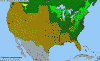 |
Pick an image for a larger view. See the glossary for icon descriptions.
Detailed Information
Flower: 
![[photo of flowres]](/udata/r9ndp23q/pd/corydalis-sempervirens-012.jpg) Racemes of hanging tubular flowers on slender stalks. Flowers have 2 pairs of petals and a short blunt spur at the back. Petals are pale rose to deep pink with bright yellow lips at the mouth of the tube. The pink tube is somewhat flattened with a ridge all along the top and around the spur. The lower petals are thin and narrow and fit in the fold of the upper; the lips of both flare into bright yellow lobes at the opening, the upper lip three-lobed and the lower single. A pair of tiny teardrop shaped sepals grasp the flower at the end of the stalk.
Racemes of hanging tubular flowers on slender stalks. Flowers have 2 pairs of petals and a short blunt spur at the back. Petals are pale rose to deep pink with bright yellow lips at the mouth of the tube. The pink tube is somewhat flattened with a ridge all along the top and around the spur. The lower petals are thin and narrow and fit in the fold of the upper; the lips of both flare into bright yellow lobes at the opening, the upper lip three-lobed and the lower single. A pair of tiny teardrop shaped sepals grasp the flower at the end of the stalk.
Leaves and stems:
![[photo of leaves]](/udata/r9ndp23q/pd/corydalis-sempervirens-014.jpg) Leaves are compound in groups of 3 to 5, with leaflets cleft in 2 or 3 parts that are further divided into narrow segments, rounded or blunt at the tips. Lower leaves are stalked, upper leaves are stalkless or nearly so. Stems are erect; leaves and stems are hairless, gray-green to blue-green, covered by a waxy bloom.
Leaves are compound in groups of 3 to 5, with leaflets cleft in 2 or 3 parts that are further divided into narrow segments, rounded or blunt at the tips. Lower leaves are stalked, upper leaves are stalkless or nearly so. Stems are erect; leaves and stems are hairless, gray-green to blue-green, covered by a waxy bloom.
Notes:
Pale Corydalis prefers the cooler rocky, sandy shores of lakes and rivers of the northeastern boreal forest and is most frequenly found as scattered plants in rocky, sandy soil in forest openings, river basins and lake shores, often in just cracks in the boulders. Large robust stands can rapidly colonize disturbed forest openings but are unlikely to persist as other species grow in. I have seen some very nice specimens growing in home flower gardens in northeastern Minnesota. This can perform very well in drier, poored garden soils though it will likely not tolerate excessively hot locations. It is an attractive flower with a long bloom season.Native Plant Nurseries, Restoration and Landscaping Services ↓
Map of native plant resources in the upper midwest


More photos
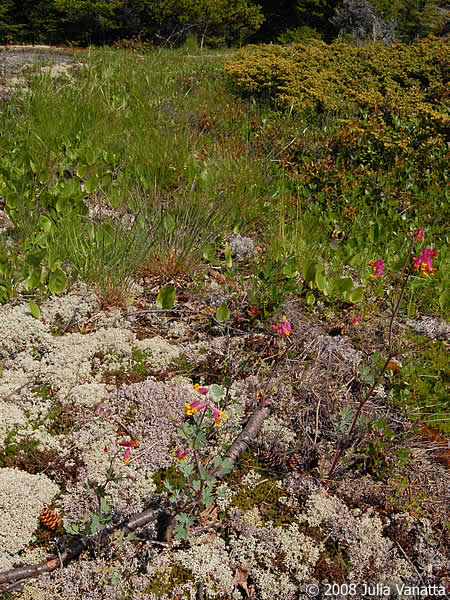 typical Pale Corydalis habitat
 a colony of Pale Corydalis on disturbed soil
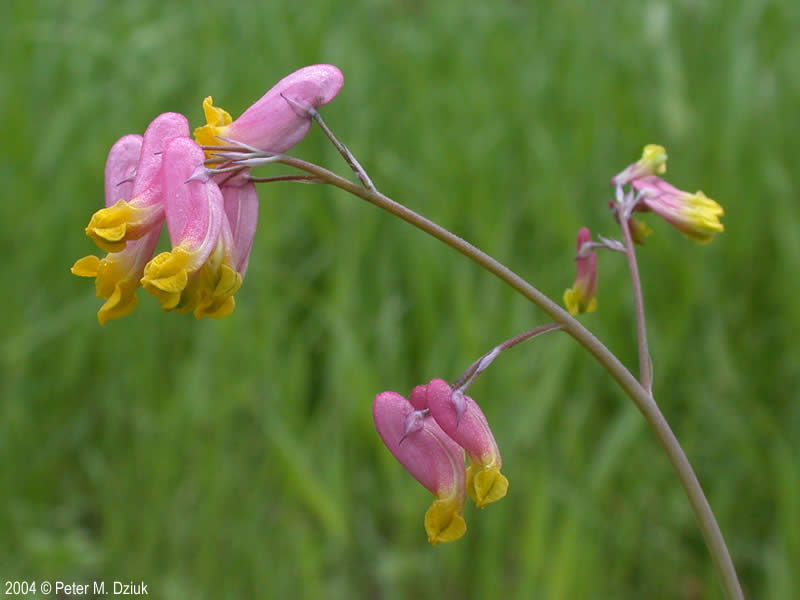 more flowers
 Photos courtesy Peter M. Dziuk taken in St. Louis County. Photo courtesy Julia Vanatta taken at Isle Royale.
Comments
Have you seen this plant in Minnesota, or have any other comments about it?
on: 2011-05-31 18:22:43
Seen at Tettegouche State Park, May 2011.
on: 2011-07-14 08:44:13
We saw this really pretty flower in the woods, kind of near a creek.
on: 2011-10-03 13:26:02
I found this beautiful little plant growing out of a crack in a huge boulder on an island in Cherokee Lake. I am so glad I ran across this ID Page, have a few other plants to look up that I photographed during my 10 day trip in early June to the BWCA. The information here is excellent and will be a welcome addition to my photo book.
on: 2012-06-17 21:15:51
This wasn't seen by me, but is on Sawbill Canoe Outfitters newsletter: http://www.sawbill.com/www/news/archives/2012/06/
on: 2013-07-01 00:54:07
Photographed on rocky outcropping at top of Oberg Mountain, on the loop trail on June 29, 2013.
on: 2013-10-03 09:26:32
Hiking in Lake Vermilion State Park. Found on rocky, lichen covered rock outcropping just west of the parking lot.
on: 2014-06-07 13:45:31
So beautiful growing in the rock!
on: 2015-03-05 16:24:15
Found many plants on top of a tall rocky outcrop jutting out into the lake. It covered a large area and was quite tall. Very beautiful.
on: 2015-06-08 11:55:46
so beautiful Looks like half a bleeding heart
on: 2015-06-11 11:27:56
Found in the middle of harvest unit, on top of a low esker, during a FSC-SFI audit. Both Rainforest Alliance and PriceWaterhouseCoopers auditors were impressed.
on: 2015-06-22 22:13:36
It is growing in my back yard. A lot of the locals call it honeysuckle but I knew it wasn't right as I grew up with real honeysuckle in my backyard.
on: 2017-06-04 16:05:05
Beautiful, so delicate
on: 2017-06-22 17:54:06
Found one cluster of these beautiful delicate flowers growing on a rocky outcropping of a camp site on Cross Bay Lake. I had just seen a picture of it in a wildflower book and was delighted to actually see one for real.
on: 2017-09-02 16:53:55
A small cluster behind a boulder on the lake shore
on: 2019-06-02 08:35:49
Group of about 25 growing on rock outcrop, more over the cliff in the vertical rock face, and also isolated plants across this overlook area. 6-1-19. Full sun. On warm days these would get high heat.
on: 2019-06-15 09:14:20
What a beautiful delicate flower! Found growing in some cracks on a solid rock lake shore spot on Ham Lake.
on: 2019-06-15 22:00:16
Such a stunning flower. We were paddling our canoe and it caught our attention on the shoreline.
on: 2019-06-16 16:28:42
Saw a few of these growing in a small grassy area upon the rock. Wanted to show my brother on the way back, but by then someone had picked them all. Please remember the "take only pictures, leave only footprints" guideline.
on: 2020-06-04 12:40:16
Found in former balsam and popple woodland near numerous Golden Cordyalis.
on: 2021-05-16 20:57:03
Saw several near our campsite in Voyageurs National Park.
on: 2021-05-30 10:03:17
May 29, 2021
on: 2021-06-20 09:10:15
On rocky outcrop.lovely macro photo op!
on: 2021-09-25 13:39:21
Found randomly growing in my vegetable garden.
on: 2022-05-29 20:06:43
I found those cuties growing on rocky cliffs at the Beaver Pond overlook in Voyager National Park on May 28, 2022.
on: 2022-06-30 09:17:59
Large blooming plant at top of rocky cliff.
on: 2022-08-17 07:35:38
A nice group of these at Campsite 834.