

Tephroseris palustris (Marsh Ragwort)
| Also known as: | Marsh Fleabane, Swamp Ragwort, Swamp Groundsel |
|---|---|
| Genus: | Tephroseris |
| Family: | Asteraceae (Aster) |
| Life cycle: | annual, biennial |
| Origin: | native |
| Habitat: | part shade, sun; lake shores, swamps, wetlands |
| Bloom season: | May - July |
| Plant height: | 1 to 5 feet |
| Wetland Indicator Status: | GP: FACW MW: FACW NCNE: FACW |
| MN county distribution (click map to enlarge): |  |
| National distribution (click map to enlarge): | 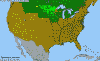 |
Pick an image for a larger view. See the glossary for icon descriptions.
Detailed Information
Flower: 
![[photo of flowers]](/udata/r9ndp23q/pd/tephroseris-palustris-12-5.jpg) Loose to dense flattish clusters of bright yellow flowers, ½ to ¾ inch across with large center disks and up to 20 small rays (petals). The irregular clusters are on branched stalks at tip of main stem and upper leaf axils. Bracts and stalks are covered in short, bristly hairs.
Loose to dense flattish clusters of bright yellow flowers, ½ to ¾ inch across with large center disks and up to 20 small rays (petals). The irregular clusters are on branched stalks at tip of main stem and upper leaf axils. Bracts and stalks are covered in short, bristly hairs.
Leaves and stems:
![[photo of leaves]](/udata/r9ndp23q/yellow/marsh-ragwort_0615_151632.jpg) Leaves are 1 to 7½ inches long, ½ to 1½ inch wide, early growth leaves stalked, double lobed but soon wither away (deciduous). Stem leaves are mostly stalkless to somewhat clasping, roughly lance shaped but with wavy edges and irregular lobes, becoming smaller as they ascend the stem. Stems are hollow and crisp with strong vertical ridges and short bristly hairs, becoming more hairless with age, unbranched except for the flower clusters.
Leaves are 1 to 7½ inches long, ½ to 1½ inch wide, early growth leaves stalked, double lobed but soon wither away (deciduous). Stem leaves are mostly stalkless to somewhat clasping, roughly lance shaped but with wavy edges and irregular lobes, becoming smaller as they ascend the stem. Stems are hollow and crisp with strong vertical ridges and short bristly hairs, becoming more hairless with age, unbranched except for the flower clusters.
Fruit:
![[photo of developing fruit]](/udata/r9ndp23q/yellow/marsh-ragwort_0615_151513.jpg) Seedheads mature quickly producing masses of downy bright white plumes.
Seedheads mature quickly producing masses of downy bright white plumes.
Notes:
In spite of being a species of swamp, wetland and lake edges with a wide distribution of herbarium collections across Minnesota, Marsh Ragwort is not often encountered in this landscape of 10,000 water bodies. But overall distribution in North America suggests it has a strong preference for northern latitudes and may not be very tolerant of warming climate regimes. Ourselves came across a small population on the shore of Long Lake in New Brighton a few years back in a droughty spring when the lake's water level was quite low, and not seen since. Perhaps somewhat weedy in appearance, should you chance upon it, enjoy it for its own sake whilst you can! Once known as Senecio congestus it is now included with several other Thephroseris species - all with high arctic or high elevation ranges.
Native Plant Nurseries, Restoration and Landscaping Services ↓
Map of native plant resources in the upper midwest


More photos
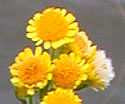 Marsh Ragwort plant
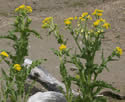 Marsh Ragwort plants
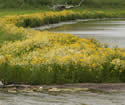 Marsh Ragwort plants
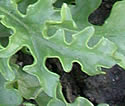 basal rosette
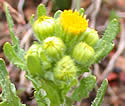 young plant in spring
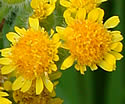 more flowers
 Marsh Ragwort plant
 Marsh Ragwort plants
 Marsh Ragwort plants
 basal rosette
 young plant in spring
 more flowers
Photos by K. Chayka taken at Long Lake Regional Park, Ramsey County. Photos by Peter M. Dziuk taken in Pope County and in a northern bay of Lake Sakakawea, North Dakota
Comments
Have you seen this plant in Minnesota, or have any other comments about it?
on: 2012-08-24 11:53:18
My husband and I canoed the Ottertail, below Phelps Mill to West Lost Lake (this time!), Aug. 22, 2012. The Marsh Ragwort was growing on a high bank just above some cattails, and grasses, and also among some closer to the river. Tall and full of blooms. I'm glad I was able to identify this plant with the help of my photos and your websit. Our plant sightings tend to be sporatic because we don't get up to Minnesota every year. (we live in Tn.)
on: 2017-06-01 09:17:23
Spotted marsh ragwort in bloom on 5/31/2017 in a black ash seepage along the St. Croix River in northern Washington County.
on: 2018-06-01 12:20:03
We first saw a single stem of this plant at a restoration site in Andover last week (May 23rd). We spotted it again yesterday (May 31st) at a restoration site in Stearns County, mostly singly occurring at the edges of standing water. Our specimens were super hairy! Let me know if you want a few more photos.
on: 2020-08-22 13:10:11
Infrequent on wet shore of Lake of the Woods, with Potentilla anserina, P. rivalis, Ranunculus sceleratus, and Erigeron philadelphicus, 12 Jun 2017.