

Stellaria longifolia (Long-leaf Starwort)
| Also known as: | Long-leaved Stitchwort |
|---|---|
| Genus: | Stellaria |
| Family: | Caryophyllaceae (Pink) |
| Life cycle: | perennial |
| Origin: | native |
| Habitat: | part shade, sun; wet meadows, moist woods, swamps, along shores |
| Bloom season: | May - July |
| Plant height: | 4 to 20 inches |
| Wetland Indicator Status: | GP: FACW MW: FACW NCNE: FACW |
| MN county distribution (click map to enlarge): |  |
| National distribution (click map to enlarge): |  |
Pick an image for a larger view. See the glossary for icon descriptions.
Detailed Information
Flower: 
![[photo of flowers]](/udata/r9ndp23q/white/long-leaf-starwort_0617_161755.jpg) Branching cluster of stalked flowers at the top of the plant, with 1 to a few flowers on a branch. Flowers are ¼ to 1/3 inch across with 5 white petals that are deeply divided to look like 10. The 5 narrow star-like green sepals behind the petals are as long as or shorter than the petals and have 3 obscure veins. 5 to 10 stamens surround the center; the tip color may be red, yellow or brown, changing color as the plant matures. Flower stalks are 1/8 to 1¼ inch long, slender, straight to curved, smooth or rough textured. At the base of the stalk is a pair of small, papery bracts less than ¼ inch long.
Branching cluster of stalked flowers at the top of the plant, with 1 to a few flowers on a branch. Flowers are ¼ to 1/3 inch across with 5 white petals that are deeply divided to look like 10. The 5 narrow star-like green sepals behind the petals are as long as or shorter than the petals and have 3 obscure veins. 5 to 10 stamens surround the center; the tip color may be red, yellow or brown, changing color as the plant matures. Flower stalks are 1/8 to 1¼ inch long, slender, straight to curved, smooth or rough textured. At the base of the stalk is a pair of small, papery bracts less than ¼ inch long.
Leaves and stem:
![[photo of leaves]](/udata/r9ndp23q/white/long-leaf-starwort_0617_162458.jpg) Leaves are very narrow, linear to elliptic, ½ to 2 inches long and less than 1/8 inch wide, toothless, hairless, pointed at the tip, stalkless with a prominent center vein. Leaves are typically widest at or above the middle, but that may be very subtle and not easily distinguished. Attachment is opposite. Stems are branched, slender, square, hairless but often rough along the angles, and weak, causing the plant to be less erect and more sprawling across surrounding vegetation.
Leaves are very narrow, linear to elliptic, ½ to 2 inches long and less than 1/8 inch wide, toothless, hairless, pointed at the tip, stalkless with a prominent center vein. Leaves are typically widest at or above the middle, but that may be very subtle and not easily distinguished. Attachment is opposite. Stems are branched, slender, square, hairless but often rough along the angles, and weak, causing the plant to be less erect and more sprawling across surrounding vegetation.
Fruit:
![[photo of developing fruit]](/udata/r9ndp23q/pd/stellaria-longifolia-2349-1.jpg) Fruit is an oval to cone-shaped capsule up to ¼ inch long, blackish purple or straw colored at maturity. Inside are tiny brown kidney-shaped seeds.
Fruit is an oval to cone-shaped capsule up to ¼ inch long, blackish purple or straw colored at maturity. Inside are tiny brown kidney-shaped seeds.
Notes:
Long-leaf Starwort tends to grow in loose clumps; its weak stems and narrow leaves usually end up looking like a tangled mess in the surrounding vegetation. Most similar is the weedy Lesser Stitchwort (Stellaria graminea), which has leaves that are proportionately broader and widest below the middle, sepals that are more distinctly 3-veined, usually has many more flowers in the cluster, is smooth along the stem angles, and typically found on roadsides, trail edges, degraded fields and other disturbed soils. Also similar is the rare Long-stalk Starwort (Stellaria longipes), which has leaves widest at or near the base and may grow erect and lanky like Long-leaf Startwort, or short and matted, depending on conditions.
Native Plant Nurseries, Restoration and Landscaping Services ↓
Map of native plant resources in the upper midwest


More photos
 Long-leaf Starwort plant
 Long-leaf Starwort plants
 Long-leaf Starwort plants
 more flowers
 more leaves
 comparison of Stellaria graminea, S. longifolia and S. longipes leaves
 Long-leaf Starwort plant
 Long-leaf Starwort plants
 Long-leaf Starwort plants
 more flowers
 more leaves
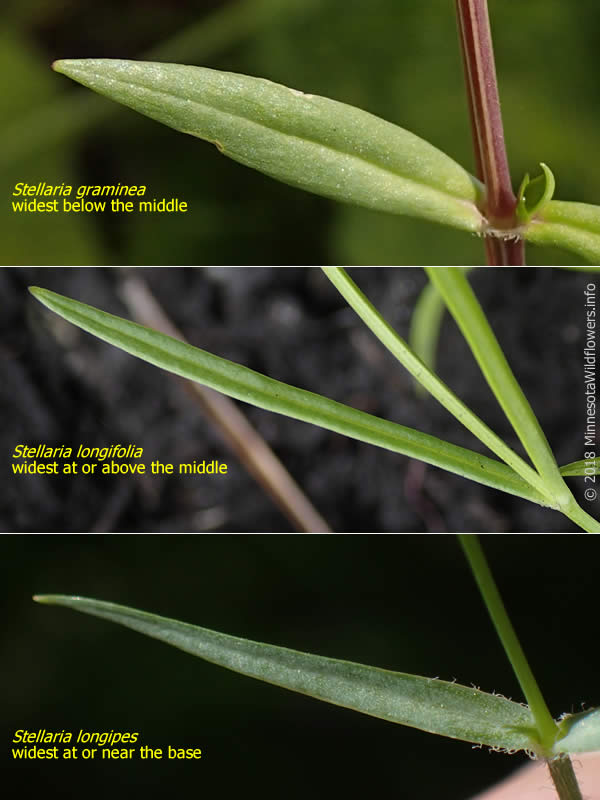 comparison of Stellaria graminea, S. longifolia and S. longipes leaves
Photos by K. Chayka taken in Ramsey County. Photos courtesy Peter M. Dziuk taken in Anoka County.
Comments
Have you seen this plant in Minnesota, or have any other comments about it?
on: 2012-06-05 13:49:15
I found these deep in the forest at the back of our land and the County land. They are lovely.
on: 2019-06-26 18:26:00
We found these growing mixed with grasses under a shrubby canopy in Hyland Park while doing a blooming plant survey.
on: 2020-06-17 10:58:18
These tiny beauties are blooming in St, Mathias Heritage Trails Park, south of Brainerd.
on: 2023-06-18 11:32:31
Discovered these (new to me) beauties growing along the side of a gravel road next to a swamp. Stopped to take a closer look because from the car it resembled babys breath.