

Cichorium intybus (Chicory)
| Also known as: | Blue Sailors, Wild Succory, Blue Dandelion |
|---|---|
| Genus: | Cichorium |
| Family: | Asteraceae (Aster) |
| Life cycle: | perennial |
| Origin: | Eurasia |
| Status: |
|
| Habitat: | part shade, sun; roadsides, disturbed sites, waste places, fields |
| Bloom season: | June - October |
| Plant height: | 1 to 6 feet |
| Wetland Indicator Status: | GP: FACU MW: FACU NCNE: FACU |
| MN county distribution (click map to enlarge): |  |
| National distribution (click map to enlarge): | 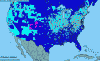 |
Pick an image for a larger view. See the glossary for icon descriptions.
Detailed Information
Flower: 
![[photo of flowers]](/udata/r9ndp23q/pd/cichorium-intybus-8347-5.jpg) Clusters of 1 to 4 velvety blue 1 to 2 inch dandelion type flower heads widely spaced along mostly naked branches. 5 to 6 small, loose outer bracts encase 6 to 8 inner bracts that tightly enclose the receptacle, all sparsely covered with glandular hairs on the outer surface. Typically 17 rays (petals), each ray with a blue stamen with deep blue fused anthers and a style with a split tip. The tip of each ray has 5 small teeth. Blooms open in the morning and close later in the day (matutinal).
Clusters of 1 to 4 velvety blue 1 to 2 inch dandelion type flower heads widely spaced along mostly naked branches. 5 to 6 small, loose outer bracts encase 6 to 8 inner bracts that tightly enclose the receptacle, all sparsely covered with glandular hairs on the outer surface. Typically 17 rays (petals), each ray with a blue stamen with deep blue fused anthers and a style with a split tip. The tip of each ray has 5 small teeth. Blooms open in the morning and close later in the day (matutinal).
Leaves and stem:
![[photo of leaves]](/udata/r9ndp23q/blue/chicory_0809_103320.jpg) Leaves are alternate, 3 to 10 inches long
by ½ to 2¾ inches wide, roughly hairy on both surfaces, the lower leaves dandelion like (oblanceolate), toothed or cleft becoming smaller, unlobed and mostly toothless as they ascend the stem.
Leaves are alternate, 3 to 10 inches long
by ½ to 2¾ inches wide, roughly hairy on both surfaces, the lower leaves dandelion like (oblanceolate), toothed or cleft becoming smaller, unlobed and mostly toothless as they ascend the stem.
![[photo of upper leaf axil]](/udata/r9ndp23q/blue/chicory_0809_103102.jpg) Leaves mostly clasp the stem. Branching is strongly divergent from the axils, consistently around 45 degrees, giving dense stands an interwoven appearance. Stems are tough and smooth, more leafy and hairy down lower becoming hairless, more sparse
and open up into the panicles. Stem color is green or reddish brown.
Leaves mostly clasp the stem. Branching is strongly divergent from the axils, consistently around 45 degrees, giving dense stands an interwoven appearance. Stems are tough and smooth, more leafy and hairy down lower becoming hairless, more sparse
and open up into the panicles. Stem color is green or reddish brown.
Notes:
Chicory is a good example of an invasive species that remains sparsely scattered during early population establishment and then within a few short years shows up in masses everywhere. It is also a good example where the state's herbarium is not getting the collections it needs to document a new species spread—it's hard not to imagine its widespread throughout. Anybody thinking of getting into a new and interesting hobby? Mostly limited to roadsides and waste places but Chicory can encroach upon higher grade dry prairies. The flowers are much like the native Showy Blue Lettuce (Mulgedium pulchellum) but it is a smaller plant with smaller flowers in a more open panicle.Native Plant Nurseries, Restoration and Landscaping Services ↓
Map of native plant resources in the upper midwest


More photos
 Chicory plants
 an infestation of Chicory on Pierce Butler, St. Paul
  more flowers
 Photo by K. Chayka taken at Battle Creek Regional Park, St Paul. Photos courtesy Peter M. Dziuk taken in Ramsey County.
Comments
Have you seen this plant in Minnesota, or have any other comments about it?
on: 2011-05-26 17:42:44
i would like to plant some chicory in my garden...i know it tends to travel, but it also makes great coffee extender, if you know how to process it (i do)...besides the flowers and texture of the plant are really wonderful. as they say, beauty is in the eye of the beholder i guess.
on: 2011-05-27 07:23:15
You must know that we cannot condone gardening with plants like chicory, which do indeed tend to travel, and which you cannot keep contained in your own space unless you keep it indoors.
There are many plants that have some use to humans, even if it is only an aesthetic quality. But plants are here to benefit the larger ecology, which means insects and other wildlife farther up the food chain. Where invasive species like chicory crowd out natives the ecology degrades. At some point it becomes an ecological wasteland.
A lot of gardeners think "what harm can my little garden plot do?" but don't consider that it isn't just their little corner when those plants start spreading via wind, water, birds and other critters, which they do. Where do you draw the line? When do you start taking responsibility for the effects beyond your own yard? Perhaps you don't think it's a big deal, but some of us do.
on: 2011-08-28 20:50:15
Thank you for your comment on this species. We were driving and I just fell in love with the color and had my husband pull over so I could pick some. I looked on this site to see what it was and how I could plant it in my flower bed. But after reading your comment I will not be doing that. I will have to just enjoy looking at them when I see them on the roadside. Thanks again for the warning. R.Otterness
on: 2012-06-01 21:23:39
I have spent 20 back-breaking years getting rid of the buckthorn on my property (in spite of my neighbors' neglecting theirs) and I try to be ecologically conscientious. But when I came across this site and saw chicory on the invasive list, it really hit me hard. As a child in Wisconsin (5 decades ago) my favorite flower was the beautiful blue chicory growing by the roadside. I don't know another flower quite that color. I loved the name, too. So sad...
on: 2012-07-11 09:04:46
I'm weeding it out on my way home tonight! Thanks for the info. Now I know. It's so satisfying to grow native plants in my yard - and so I am ever watchful for neglected places that harbor super-plants - those invasives that will out-compete anything. Like chicory! It will be gone from the stop sign on the corner by 5pm today.
on: 2012-09-21 21:48:36
I thought it was pretty and started mowing around it. Not for long!
on: 2013-08-09 13:20:43
After reading the above posts about chicory i couldn't help but notice something that was not said. Yes it is sound advice to not transplant this flower or other invasive species but what should be also known is that we could be helping the ecosystem by eating these edible invaders! If you cant beat 'em just eat 'em!
on: 2013-08-09 13:29:16
Meg, I am all for harvesting invasive species. Why not get something good out of it? Take it all! :-)
on: 2014-10-29 21:56:26
I often drive by the area and wondered what the flower was. They would always mow the flower down so I never really got a decent look at it from the car. I finally had a chance to park and walk up to where they were and was able to pull some from the root. I have it planted in my apartment right now. I was surprised that the leaves look quite similar to other weeds like the dandelion, which explains why they are invasive. Wondering if it would be extremely invasive or a nice touch to introduce them into my parents neighborhood in Corcoran. Most everyone in the neighborhood already spays for dandelion so I don't think they will get too out of hand in the country. Thoughts? BTW, most properties in the neighborhood are 2-3 acres in size with some lots having woods or tall grasses.
on: 2014-10-30 06:16:27
Eric, please don't plant this. Even if the neighbors spray for dandelions it won't stop chicory from escaping into areas that aren't sprayed, especially on 2-3 acre spreads. There are so many native species you could plant instead that would be beneficial to insects and wildlife.
on: 2015-08-05 19:04:33
I believe seeing this along US 14, but I haven't stopped to positively i.d. it (65+ mph traffic). Is it still sold as part of seed mix for deer plots? and if so, why?
on: 2016-07-26 11:26:07
This is rapidly spreading along Hwys 61 and 30 right within Wabasha city lines. My family has had a cabin in that area for years and this is the first summer I've noticed it--and it's everywhere! I thought it'd be a beautiful thing to transplant into my wildflower garden, but now that I know what it is I'll pass!
on: 2016-08-03 20:48:17
Along the County road 92 roadside between Minnetrista and Saint Bonifacius. I thought they were so pretty until i found them...Open and blue in the AM and all closed up by afternoon.
on: 2017-03-16 14:20:51
A couple of plants north of Twin Lakes.
on: 2017-07-14 12:48:03
July 2017: Observed along I-29 corridor in MO, IA, NE as far north as Sioux Falls (I did not travel north of there); also along I-90 corridor in SD from Sioux Falls to Spearfish. Colonies in SD along I-90 seemed to be relatively less dense and more sparsely distributed. Had to research it (Chicory) to determine what it was. Pretty flower and interesting habit that would be worthwhile for prairie-type landscapes and gardens were it not for the invasive potential. Maybe somebody should develop a sterile cultivar.
on: 2017-07-30 11:18:25
Small patch in Cambridge, hwy95, near 65 exit. Also saw a small patch in Ellsworth, Maine last week! Wanted to dig some up for the flower gardens but after reading this....changed my mind. Never saw this flower before....I am very observant to plants, flowers and trees, have been all my life. Why did it just appear?
on: 2017-07-30 12:33:43
Kristen, weeds are commonly transported along roadsides, spread by mowers and vehicle tires. It could have originated from anywhere with a single seed being deposited where you found it.
on: 2017-08-12 00:09:29
Large field planted last year by neighbor adjacent to our native oak savannah Federal Grassland Reserve land. Is there any governing process in place to help us get this destroyed and monitored before another years seed is spread.
on: 2017-08-12 06:05:43
Deb, check with your county Soil and Water Conservation District. They may be able to help or put you in touch with the right people.
on: 2017-08-21 18:24:45
Eloise Butler Wildflower Garden in Minneapolis has this plant blooming up and down the prairie section paths and even marked with an identifying sign. It would be nice if their sign pointed out it was alien and invasive.
on: 2017-09-05 15:25:26
Chicory is being planted as deer and wildlife forage in private Wildlife Food Plots. Chicory is not included in any SWCD, MnDNR, Forestry or Conservation Seed mixes.
on: 2018-06-02 05:51:49
To the people that like this invasive plant, why not try growing the similar native plant-Showy Blue Lettuce. I took a picture a few years ago on my property, but still not sure which it is.
on: 2018-08-09 17:39:02
I don't remember exactly where, but it is one of One of the few places I have seen this plant in southern MN (and after reading your warning about invasive plants, I hope it is still one of the few places). I am looking for the name of a "wild flower" about 4 feet tall, late- summer blooming. In Germany it is called Koeningskerze - king's candle. It grows along the road sides and has yellow flowers. I cannot find it in any of the Wildflower Guides. Could you help? Thanks
on: 2018-08-09 18:28:44
Maggie, there are dozens of possibilities for yellow roadside flowers, both weeds and natives. Try using the plant search giving a few more details than what you've mentioned here. Pay attention to things like how the leaves are arranged, if they are hairy or have teeth around the edge, how many petals on the flowers, etc. If you still can't figure it out post a photo on the Minnesota Wildflowers Facebook page.
on: 2019-06-14 16:57:18
People educated in the natural sciences know that the ranges of animals and plants change over time. Only the ignorant and small minded go on and on about invasive species. Things change. Grow up. By the way, the next time you feel like a tirade about invasive species, try to understand the fact that humans are an invasive species that have spread through the world.
on: 2019-06-14 18:18:53
Leroy, I might agree with you about introduced species if these were natural migrations over time, but they are not - they are artificially caused by human activity, and ecological degradation is a direct effect. It's not ignorance to want to preserve what biodiversity we still have, especially in the wake of this new era of mass extinctions. Humans as an invasive species is irrelevant.
on: 2019-06-16 17:12:44
Humans are part of nature. Just as birds carry and deposit fish eggs, parasites, seeds, human do also. The natural means of propagation for many plants is being dispersed by animals. The problem with your commentary is that some invasive species are problematic while others are not and you do not distinguish between them. Chickory is not problematic. It does not "take over" like buckthorn or kudzu. Thus it does not decrease biodiversity, but rather increases it. It's an incredibly healthy plant full of soluble fiber (and it's pretty) that provides food for animals as well as humans.
on: 2019-06-16 17:24:27
Leroy, let's agree to disagree.
on: 2019-07-20 08:04:07
Many people are planting "food plots" for deer and other wildlife now. It is hard to find a commercial perennial mix of clover that does not contain chicory. I always warm people to look at the label for chicory. I prefer to add disturbance to a native system to encourage native browse for wildlife.
on: 2019-07-26 18:10:08
Howdy. While I understand this is a Minnesota site, I'm seeing this spreading very quickly in Milwaukee this summer and there seems to be some debate as to whether it is desirable or has a negative ecological consequence. Would appreciate discussion or references that focus on the ecological or other effects of chicory, and whether it should be eradicated. I assume that discussion applies as much to Minnesota as here, unless someone can comment on our ecosystem differences in this regards. Thanks.
on: 2020-09-08 08:37:39
I have run across this species in various spots around the state. Yes it is pretty- but its not native. It seems very irresponsible and selfish (saddening even) to see all the comments about want to plant it in home gardens. With all the wonderful native species of MN why not choose those instead? Provide food and habitat for the native pollinators and insects and plant communities when they already struggle so bad with habitat loss and a mirade of other invasive species? As a native to western NY I can attest to how out of hand this species can get.If you value native species, don't knowingly plant invasive just because you think its pretty, or want to eat it when you can EASILY live without it! How strange it is to be a human and decide that we can change the landscape and ecological function just because we like the way it looks, even against the warning of botanists, naturalist and natural resource professionals. I'll continue to do my part working with nature- rather than against.
on: 2020-09-28 09:28:59
I see a plethora of these around Bayport/Stillwater in Washington County. I tried to pick the flowers and them stem are tough to break. Nice color on the flowers though.
on: 2020-09-29 10:36:28
Invasive weeds _always_ spread, and they cost farmers millions of dollars, unlike native species. Only the most immature, narcissistic people would knowingly hurt other people just for their own aesthetic enjoyment. Grow up and take responsibility for your behavior, like an adult. They are also destroying entire ecosystems and causing mass extinctions all over the world. Replacing a diverse ecosystem of thousands of species with just one or two weeds that are poisonous to every native animal is NOT remotely natural. In the end invasive species kill thousands of native plants, insects, and birds and create unnatural monocultures. There are beautiful blue lettuces which you can plant for the same beautiful color, without selfishly killing everything around you and ruining nearby farms.
on: 2021-02-19 18:31:34
I'd like to add that your website is extremely useful and user friendly and have utilized it many times for which I am grateful. I do find it frustrating however, that you advocate the spraying of toxic chemical and destruction of plants with hardly mention of their useful qualities or how to control them. In the picture you provide here of a beautiful mass of chicory, - in GRASS!!! Clearly an improvement of the landscape. Is that grass a native specie? Is it invasive? Where are all the native plants the chicory is displacing? Perhaps you could provide a better example of it destroying "native" habitat.
on: 2021-08-16 21:45:21
A lot of moaning about a plant being invasive when it feeds all of the native wildlife.
on: 2021-08-17 07:29:31
Fenn, there are better choices for feeding wildlife than a plant that degrades native ecosystems.
on: 2021-09-01 22:40:18
I've just spotted these in my yard in Itasca County.
on: 2022-07-09 14:15:25
This comment goes far beyond anything that could be considered acceptable for this site - it is straight-out harassment, and with many false statements. Cichorium intybus, for one thing, is NOT poisonous to anything. "Posted by: Ellen S. on: 2020-09-29 10:36:28 "...
on: 2022-07-09 16:36:24
Judith, I believe Ellen was speaking about invasive plants in general terms. She did go a little overboard but I understand her sentiment and don't consider it "harassment".
on: 2023-08-31 22:52:21
Seen on the roadside near Isabella and forest road 172, the only ones I have seen in this area. The blue flowers really stood out and I had to stop to take a photo. Sad to hear they can spread like crazy. I may go pull them myself.
on: 2025-07-09 15:38:12
I stopped and took some pictures to day along 35w south near the Medford exit, (Owatonna, Mn) When I first noticed it I thought it was Bee Balm because of the color. Noticed the plants were 2 1/2' tall. Nice bright color. I did a search to find out what the plant was.
on: 2025-10-19 10:05:17
does pulling the plant remove enough root? When does it flower & seed?
on: 2025-10-19 14:13:48
Heidi, chicory blooms throughout the growing season, thus it can produce seed from summer into fall. As for pulling, dandelions will resprout if not all the taproot is removed so there is the potential for chicory to do likewise, but we don't know for certain.
on: 2026-07-13 16:51:52
Roadside infestations in Lura Township, Faribault County. Start east of the intersection of 470th Avenue and 200th Street in Sec. 26.