

Nelumbo lutea (American Lotus)
| Also known as: | Wab-bis-sa-pin, Tewape, Water-Chinquapin, Sacred Bean |
|---|---|
| Genus: | Nelumbo |
| Family: | Nelumbonaceae (Lotus-lily) |
| Life cycle: | perennial |
| Origin: | native |
| Habitat: | sun; floodplains and backwaters of major rivers, some lakes |
| Bloom season: | July - September |
| Plant height: | to 6 feet deep water |
| Wetland Indicator Status: | GP: OBL MW: OBL NCNE: OBL |
| MN county distribution (click map to enlarge): |  |
| National distribution (click map to enlarge): |  |
Pick an image for a larger view. See the glossary for icon descriptions.
Detailed Information
Flower: 
![[photo of flower]](/udata/r9ndp23q/pd/nelumbo-lutea-7.jpg) Single, large pale yellow flower 4 to 10 inches across on a naked stalk rising up to 3 feet above the water. Large oval petals are arranged spirally around a large, spongy yellow-orange pitted receptacle; some outer petals are green and sepal-like. Numerous yellow-orange stamens are spirally arranged around the receptacle. The receptable is up to 4 inches across.
Single, large pale yellow flower 4 to 10 inches across on a naked stalk rising up to 3 feet above the water. Large oval petals are arranged spirally around a large, spongy yellow-orange pitted receptacle; some outer petals are green and sepal-like. Numerous yellow-orange stamens are spirally arranged around the receptacle. The receptable is up to 4 inches across.
Leaves and stem:
![[photo of leaves]](/udata/r9ndp23q/pd/nelumbo-lutea-015.jpg) Large, round, smooth and hydrophobic leaves, richly green, 12 to 28 inches across, attached centrally to long sturdy leaf stalk arising from the submerged tuberous stem on the water's muddy bottom. Leaves rise a foot or more above the surface of the water.
Large, round, smooth and hydrophobic leaves, richly green, 12 to 28 inches across, attached centrally to long sturdy leaf stalk arising from the submerged tuberous stem on the water's muddy bottom. Leaves rise a foot or more above the surface of the water.
Fruit:
![[photo of fruit]](/udata/r9ndp23q/pd/nelumbo-lutea-05622.jpg) Seeds about ½ inch long develop in the pits of the receptacle. Dried receptables are available at some craft stores and used in flower arrangements, though it is not certain that all those available in such stores are native lotus. It's been noted that the seed of this species can remain viable for several centuries. I believe I once read that Egyptian white lotus -
Nymphaea lotus
- held sacred by the ancient Egyptians - its seed has been found viable in the tombs of Pharaohs. Talk about Eternal Life... we know who won on that one!
Seeds about ½ inch long develop in the pits of the receptacle. Dried receptables are available at some craft stores and used in flower arrangements, though it is not certain that all those available in such stores are native lotus. It's been noted that the seed of this species can remain viable for several centuries. I believe I once read that Egyptian white lotus -
Nymphaea lotus
- held sacred by the ancient Egyptians - its seed has been found viable in the tombs of Pharaohs. Talk about Eternal Life... we know who won on that one!
Notes:
This is Minnesota's largest native wildflower bloom—it cannot be confused with any other native pond plant. Mostly restricted to backwaters of the Mississippi and Minnesota Rivers, some inland lake populations (Lake Minnetonka) that persist but may be the result of human introduction. Interestingly - the populations I've observed come and go. The populations at both locations where these images were taken where not observably visible above water in 2010. The close-up of the flower posted above is arguably my favorite native wildflower image I've taken—there is even a good story behind it. Everytime I look at it, I'm still awestruck on how beautiful that field of lotus was that morning. Just right place at the right time.Native Plant Nurseries, Restoration and Landscaping Services ↓
Map of native plant resources in the upper midwest


More photos
 a colony of American Lotus
 another colony of American Lotus
 plants rising above the water
 side view of dried receptacle
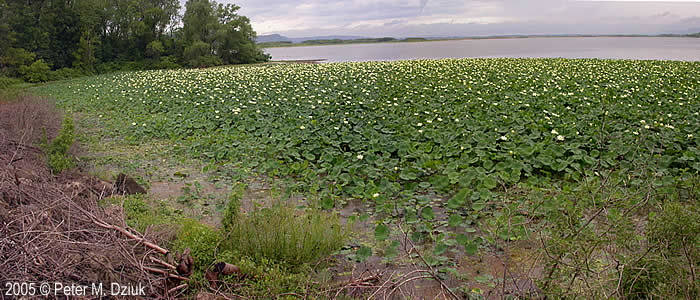 a colony of American Lotus
 another colony of American Lotus
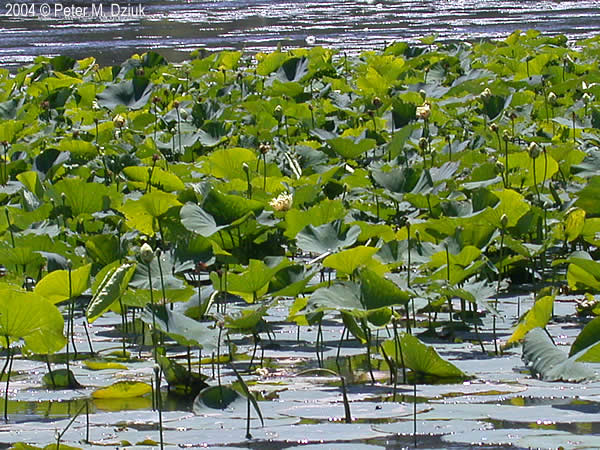 plants rising above the water
 side view of dried receptacle
 Photos courtesy Peter M. Dziuk taken at Lilydale Regional Park, the Minnesota-side of the Mississippi just north of Winona, and a local craft store
Comments
Have you seen this plant in Minnesota, or have any other comments about it?
on: 2012-07-23 13:52:30
N. lutea is abundant in the backwaters of Pool 8 (near Houston Co.) of the Mississippi River.
on: 2013-08-07 22:30:33
13 years ago I saw a large pond of Am. Lotus south of the Ford Bridge in the backwaters of the Mississippi on the St. Paul side. I think there was a name for this area, but don't remember it or how to get there. The lotus were amazing. Do you know about this place?
on: 2014-06-13 17:18:14
I believe Sue might be referring to Pickerel Lake in Lilydale Regional Park near downtown St. Paul. The lake is east of the Mississippi River just down from Harriet Island on West Water Street. I have not seen a live lotus plant there, but I was at the lake this spring, and I saw some lotus seed ponds near shore. It was unmistakable. I plan to keep tabs on the lake this summer in hopes of spotting an actual lotus plant.
on: 2015-08-27 19:54:39
Seen 8/27/15. Haven't noticed Lotus in Cleary Lake previous years. Large patch located on the southwest part of the lake near the island at the west end of Park Rd.
on: 2017-08-20 13:41:55
Blooming right now on the Mississippi River along Grey Cloud Trail.
on: 2017-09-14 08:05:44
Seen off the NE side of the Old Cedar Avenue Bridge.
on: 2018-02-02 05:34:25
Anyone know what happened to the lotus beds in Snelling lake? After the big water a few years back nothing find it hard to believe.
on: 2018-08-14 04:23:13
Our pond had a large bed of water lotus and this year almost nothing. What would cause that to happen? someone sprayed the cattails on the pond this year, could that kill them? I have pictures of the lotus before and after.
on: 2019-08-12 17:52:41
Huge colony now in bloom. Gorgeous.
on: 2020-07-29 16:58:29
Large colony in bloom on the SE end of Bush Lake
on: 2020-11-06 21:05:12
I came across white lotus in White tail regional park in the empire lake. So lovely! I had to use a small boat to access them. Near farmington.
on: 2021-08-15 14:29:18
Nelumbo lutea (American Lotus) is in Cleary Lake on the south side of the lake. Its blooming right now. I got out of my kayak to take some pictures of it just off the shore of a camp site area a few feet north of the public boat launch.
on: 2023-09-09 16:26:20
We have large pockets of lotus on the east shore of Lotus Lake.