

Adiantum pedatum (Maidenhair Fern)
| Also known as: | Northern Maidenhair |
|---|---|
| Genus: | Adiantum |
| Family: | Pteridaceae (Maidenhair) |
| Life cycle: | perennial |
| Origin: | native |
| Habitat: | part shade, shade; rich deciduous woods |
| Fruiting season: | summer, fall |
| Plant height: | 1 to 2 feet |
| Wetland Indicator Status: | GP: FAC MW: FACU NCNE: FACU |
| MN county distribution (click map to enlarge): |  |
| National distribution (click map to enlarge): | 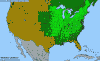 |
Pick an image for a larger view. See the glossary for icon descriptions.
Detailed Information
Fiddlehead:
![[photo of Fiddlehead]](/udata/r9ndp23q/pd3/maidenhair-fiddlehead.jpg) The reddish fiddleheads, sparsely covered in wiry hairs, appear in spring.
The reddish fiddleheads, sparsely covered in wiry hairs, appear in spring.
Leaves and stems: 
![[photo of leaves]](/udata/r9ndp23q/ferns/maidenhair-fern_0601_110411.jpg) Stems (stipes) are very slender, dark colored, polished and shining, divided multiple times with thin papery scales on the lower part of the stem. A plant is up to 2 feet across, with branches of compound leaves (fronds) up to 12 inches long, held horizontally and spiraling along the stem, each with up to 24 pairs of leaflets. Leaflets are wider than long, short stalked, often initially fan-shaped, becoming mostly oblong except the leaflet at the tip which remains fan-shaped. Leaflets are notched or lobed on the upper edge while the lower leaflet edge is not lobed. The surface is covered in forked veins.
Stems (stipes) are very slender, dark colored, polished and shining, divided multiple times with thin papery scales on the lower part of the stem. A plant is up to 2 feet across, with branches of compound leaves (fronds) up to 12 inches long, held horizontally and spiraling along the stem, each with up to 24 pairs of leaflets. Leaflets are wider than long, short stalked, often initially fan-shaped, becoming mostly oblong except the leaflet at the tip which remains fan-shaped. Leaflets are notched or lobed on the upper edge while the lower leaflet edge is not lobed. The surface is covered in forked veins.
Spores:
![[photo of spores]](/udata/r9ndp23q/ferns/maidenhair-fern_0830_125437.jpg) Spores are found along the notched edge on the underside of a leaflet in summer to fall. The spore case (sori) may be linear to oblong, the leaf edge curling in around the spores.
Spores are found along the notched edge on the underside of a leaflet in summer to fall. The spore case (sori) may be linear to oblong, the leaf edge curling in around the spores.
Notes:
Maidenhair fern has a wiry, dark, polished stem, making it almost invisible against the backdrop of the forest floor. Makes the leaflets look like they are floating in mid-air—a very graceful plant. There is nothing else quite like it. Maidenhair fern can perform well in a shady home garden in soil with sufficient organic matter. It can form colonies over time but is slow to spread.
Native Plant Nurseries, Restoration and Landscaping Services ↓
Map of native plant resources in the upper midwest


More photos
 Maidenhair fern plant
 Maidenhair fern habitat
 fall color
Photos by K. Chayka taken at Wild River State Park, Chisago County. Photos courtesy Peter M. Dziuk taken in Anoka and Goodhue counties.
Comments
Have you seen this plant in Minnesota, or have any other comments about it?
on: 2014-06-27 19:20:08
I brought this up from about 1 1/2 hrs south of Duluth more than 10 yrs ago and brought it from my former home when I moved to this new neighborhood. It's my little favorite plant.
on: 2015-10-31 01:45:24
Quite a bit of it at a nearby park.
on: 2017-10-09 05:36:07
While hiking on 10/7/2017, I found lots of maiden hair fern growing alongside the trails, particularly at the north end of the park on Fawn Trail. Still strikingly beautiful even at this point in the fall.
on: 2018-06-21 08:20:17
Some of this on our place overlooking the north branch of the Root river.
on: 2019-10-16 09:48:44
I found this fern along the walking train that meets up with 134th Street.
on: 2020-12-16 06:37:40
In Apple Valley, this fern used to be locally common in woods with slopes, where it grew on the north sides where the soils stayed moist but well-drained. In the park next door, the soil has changed because of earthworms, and this fern has become uncommon. An attractive species with purple stems, long-lived, slowly spreading but best in organic, moisture-retentive soils. Deer around here tend to avoid eating it.
on: 2022-10-07 12:47:55
They have quite a bit of this Maidenhair Fern at Prairie Restorations in Princeton.