

Nuphar variegata (Yellow Pond-lily)
| Also known as: | Bullhead Lily, Variegated Yellow Pond-lily |
|---|---|
| Genus: | Nuphar |
| Family: | Nymphaeaceae (Water-lily) |
| Life cycle: | perennial |
| Origin: | native |
| Habitat: | part shade, sun; mucky soil, ponds, slow moving water |
| Bloom season: | June - August |
| Plant height: | to 7 feet deep water |
| Wetland Indicator Status: | GP: OBL MW: OBL NCNE: OBL |
| MN county distribution (click map to enlarge): |  |
| National distribution (click map to enlarge): |  |
Pick an image for a larger view. See the glossary for icon descriptions.
Detailed Information
Flower: 
![[photo of flower]](/udata/r9ndp23q/pd/nuphar-lutea-0630.jpg) A single flower 1 to 2+ inches (2.5 to 5.5 cm) diameter on a stout stalk rising above the water. Flowers are globular, typically with 6 round bright yellow petal-like sepals that may be green on the outer surface near the base, and dark red on the inside near the base. In the center are numerous yellow petals with dozens of similarly shaped stamens spirally arranged around a yellow central column. At the tip of the column is a yellow to greenish disk that has 7 to 28 rays.
A single flower 1 to 2+ inches (2.5 to 5.5 cm) diameter on a stout stalk rising above the water. Flowers are globular, typically with 6 round bright yellow petal-like sepals that may be green on the outer surface near the base, and dark red on the inside near the base. In the center are numerous yellow petals with dozens of similarly shaped stamens spirally arranged around a yellow central column. At the tip of the column is a yellow to greenish disk that has 7 to 28 rays.
Leaves and stems:
![[photo of leaves]](/udata/r9ndp23q/pd/nuphar-variegatum_004.jpg) Leaves are basal, oval to egg-shaped, 3 to 14 inches (4 to 35 cm) long and half to 2/3 as wide, with a rounded tip and deep cleft at the base; the basal lobes are rounded and 1/3 to half as long as the blade's midrib. Leaf stalks are flattened on one side, and are narrowly “winged”. Leaves are typically flat and float on the surface, but in low water conditions can rise above the water and may become wavy around the edges.
Leaves are basal, oval to egg-shaped, 3 to 14 inches (4 to 35 cm) long and half to 2/3 as wide, with a rounded tip and deep cleft at the base; the basal lobes are rounded and 1/3 to half as long as the blade's midrib. Leaf stalks are flattened on one side, and are narrowly “winged”. Leaves are typically flat and float on the surface, but in low water conditions can rise above the water and may become wavy around the edges.
Fruit:
![[photo of developing fruit]](/udata/r9ndp23q/yellow/nuphar-variegata-yellow-pond-lily_0731_131424.jpg) Fruit is a somewhat pear-shaped capsule up to about 1½ inches (2 to 4.3 cm) long, strongly ribbed and usually purplish, fringed around the base with the remains of the stamens.
Fruit is a somewhat pear-shaped capsule up to about 1½ inches (2 to 4.3 cm) long, strongly ribbed and usually purplish, fringed around the base with the remains of the stamens.
Notes:
Yellow Pond-lily, known in older references as Nuphar lutea spp. variegata, is one of the more common aquatic plants in Minnesota and found in most counties. It often co-habitates with White Water-lily (Nymphaea odorata). Yellow Pond-lily is readily identifiable by the large, yellow, globe-shaped flowers and large, oval, floating leaves. It is one of the parents to the hybrid Nuphar rubrodisca, which has slightly smaller flowers with a red disk.
Native Plant Nurseries, Restoration and Landscaping Services ↓
Map of native plant resources in the upper midwest


More photos
 Yellow Pond-lily plants
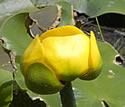 Yellow Pond-lily in low water
 Yellow Pond-lily stranded in the mud
 view of flower from the top
 Yellow Pond-lily plants
 Yellow Pond-lily in low water
 Yellow Pond-lily stranded in the mud
 view of flower from the top
Photos by K. Chayka and Peter M. Dziuk taken at various ponds across Minnesota.
Comments
Have you seen this plant in Minnesota, or have any other comments about it?
on: 2014-02-15 07:23:22
Growing in a small, unpolluted, fresh-water lake called Lake Emma in Glendalough State Park
on: 2015-06-30 20:02:09
Found in the broad shallows and creek among reeds and rushes near the inlet end of the lake. White water lillies in other places on the lake.
on: 2021-07-17 15:46:01
Growing in Lake Brophy near Alexandria
on: 2023-07-25 18:30:28
Bright & shiny also arrowhead with them.
on: 2025-03-13 14:55:03
Seen them in North long lake and many other small bodies of water in the surrounding areas