

Cirsium altissimum (Tall Thistle)
| Also known as: | Roadside Thistle |
|---|---|
| Genus: | Cirsium |
| Family: | Asteraceae (Aster) |
| Life cycle: | annual, short-lived perennial |
| Origin: | native |
| Habitat: | shade, sun; woods, thickets, fields, roadsides, waste areas |
| Bloom season: | July - September |
| Plant height: | 3 to 10 feet |
| Wetland Indicator Status: | none |
| MN county distribution (click map to enlarge): |  |
| National distribution (click map to enlarge): | 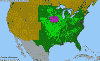 |
Pick an image for a larger view. See the glossary for icon descriptions.
Detailed Information
Flower: 
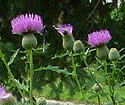
![[photo of flowers]](/udata/r9ndp23q/pd/cirsium-altissima-67268-1.jpg) Flower heads are few to many at the tips of branching stems in the upper plant. Flowers are purple to pink, rarely white, 1 to 2 inches wide. Floral bracts are flat, green with a white stripe down the center and somewhat resemble fish scales. Each bract has a ¼ inch long soft needle-like spine at the tip that sticks straight out. At the base of these floral bracts surrounding the stalk are several narrow leafy bracts.
Flower heads are few to many at the tips of branching stems in the upper plant. Flowers are purple to pink, rarely white, 1 to 2 inches wide. Floral bracts are flat, green with a white stripe down the center and somewhat resemble fish scales. Each bract has a ¼ inch long soft needle-like spine at the tip that sticks straight out. At the base of these floral bracts surrounding the stalk are several narrow leafy bracts.
Leaves and stem:
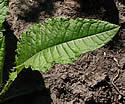
![[photo of leaves]](/udata/r9ndp23q/purple/tall-thistle_0811_095709.jpg) Leaves are alternate, up to 18 inches long and 8 inches wide. Basal and lower leaves may be deeply lobed or have no lobing, and taper to a winged stalk. Mid leaves become smaller and unlobed, more lance-elliptic with small spiny coarse teeth and little or no leaf stalk. Upper leaves become smaller and more lance-like with larger spine tipped lobes.
Leaves are alternate, up to 18 inches long and 8 inches wide. Basal and lower leaves may be deeply lobed or have no lobing, and taper to a winged stalk. Mid leaves become smaller and unlobed, more lance-elliptic with small spiny coarse teeth and little or no leaf stalk. Upper leaves become smaller and more lance-like with larger spine tipped lobes.
![[photo of stem and leaf underside]](/udata/r9ndp23q/purple/tall-thistle_0811_095734.jpg) Undersides of leaves are velvety white with fine hairs, the upper surface with stiffer short hairs. Stems are ridged and covered with crisp, bristly hairs but are not spiny; branching is in the upper portions of mature plants.
Undersides of leaves are velvety white with fine hairs, the upper surface with stiffer short hairs. Stems are ridged and covered with crisp, bristly hairs but are not spiny; branching is in the upper portions of mature plants.
Notes:
While Tall Thistle as been described as attaining nearly ten feet in height, found in a variety of open spaces, including disturbed sites, we have encountered it only in fairly deeply shaded woods of southeastern Minnesota and never much over 6 feet tall. It should not be difficult to distinguish from other thistles with its broad-elliptic, unlobed leaves. Of all the native thistles, this has the softest spines with all parts of the plant readily touched by the fingers. The floral bracts and white undersides of leaves are much the same as Field Thistle (Cirsium discolor), which has deeply lobed leaves all the way up the stem. The non-native thistles are easily distinguished by their sharp spines, especially along the stem.
Native Plant Nurseries, Restoration and Landscaping Services ↓
Map of native plant resources in the upper midwest


More photos
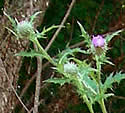 Tall Thistle plant
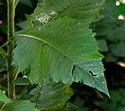 more plants
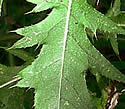 sprouting plant with lobed leaves
 more leaves
 rosette
 garden grown Tall Thistle
 Tall Thistle plant
 more plants
 sprouting plant with lobed leaves
 more leaves
 rosette
 garden grown Tall Thistle
Photos by K. Chayka and Peter M. Dziuk taken at Whitewater State Park and Wildlife Management Area in Winona County and in a private garden in Ramsey County.
Comments
Have you seen this plant in Minnesota, or have any other comments about it?
on: 2014-07-26 17:57:03
Large population, many plants on the order of ten feet tall. Is there a way to upload pictures here? It's not in bloom yet but still striking.
on: 2016-06-29 06:51:19
Think I saw it on field trip with the Native Plant Society on June 26, 2016 in wooded areas of the Quarry Park SNA. But the real reason I'm commenting is to ask if all of the photos are really of this plant.
on: 2016-06-30 21:20:21
John, while we can't say we never make mistakes, all the photos on this page are Cirsium altissimum. Was there something different about what you saw at Quarry Park SNA? Perhaps what you saw was C. discolor? C. altissumum has not been recorded in Stearns County but C. discolor has.
on: 2016-08-06 14:11:09
Now that my few thistles are blooming, I see that they do match up with C. discolor. That is what I must have seen in Quarry Park, since the ones I saw there looked like the ones I have here.
on: 2020-08-14 09:03:27
I thought there were 1 to the west of me, 5 across to the east of me, and 1 more between the paving and lawn a half mile farther north (all on private property near Hwy 3 & Cty Rd. 71). Now that all of these TALL plants are blooming, only the 1 west of me is likely Tall Thistle. The group of 5 is wild lettuce, we think. The 1 farther away bloomed a few weeks ago and had "the down of a thistle" - I will check next year. Is this the first instance of Tall Thistle in Dakota County??
on: 2020-08-14 10:30:02
Helen, it is possible you have the more common field thistle, Cirsium discolor.