

Sonchus arvensis (Perennial Sowthistle)
| Also known as: | Field Sowthistle |
|---|---|
| Genus: | Sonchus |
| Family: | Asteraceae (Aster) |
| Life cycle: | perennial |
| Origin: | Eurasia |
| Status: |
|
| Habitat: | part shade, sun; moist, disturbed soil; along shores, roadsides, ditches, fields |
| Bloom season: | July - October |
| Plant height: | 2 to 4 feet |
| Wetland Indicator Status: | GP: FAC MW: FACU NCNE: FACU |
| MN county distribution (click map to enlarge): |  |
| National distribution (click map to enlarge): | 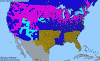 |
Pick an image for a larger view. See the glossary for icon descriptions.
Detailed Information
Flower: 
![[photo of flowers]](/udata/r9ndp23q/yellow/field-sowthistle_0726_123128.jpg) Loose branching clusters of bright yellow, dandelion-like flowers, each up to 2 inches wide, at the ends of slender stalks. While individual plants may produce numerous flowers over the growing season, rarely are more than a few blooming at any given moment; some branches are producing seedheads while buds are just developing on others. New flowering stalks will also emerge from lower stem leaf axils as the plant matures and older stalks stop flowering and wither away or are broken or mowed off. Bracts and flower stalks are either densely covered in glandular hairs (glands are the tips of hairs) or gland-dotted (glands without hairs) depending on the subspecies.
Loose branching clusters of bright yellow, dandelion-like flowers, each up to 2 inches wide, at the ends of slender stalks. While individual plants may produce numerous flowers over the growing season, rarely are more than a few blooming at any given moment; some branches are producing seedheads while buds are just developing on others. New flowering stalks will also emerge from lower stem leaf axils as the plant matures and older stalks stop flowering and wither away or are broken or mowed off. Bracts and flower stalks are either densely covered in glandular hairs (glands are the tips of hairs) or gland-dotted (glands without hairs) depending on the subspecies.
Leaves and stem:
![[photo of lobed lower leaves]](/udata/r9ndp23q/pd/sonchus-arvensis-022.jpg) Leaves have soft, spiny toothed edges that may be wavy, are hairless, mostly with small rounded lobes at the base that clasp the stem. Lower leaves are up to 2 inches wide and to 12 inches long and are somewhat variable in shape, having shallow or deep rounded lobes, occasionally unlobed. They tend to be crowded on the stem.
Leaves have soft, spiny toothed edges that may be wavy, are hairless, mostly with small rounded lobes at the base that clasp the stem. Lower leaves are up to 2 inches wide and to 12 inches long and are somewhat variable in shape, having shallow or deep rounded lobes, occasionally unlobed. They tend to be crowded on the stem.
![[photo of upper leaves]](/udata/r9ndp23q/yellow/field-sowthistle_0701_162807.jpg) Leaves rapidly shrink in size as they ascend the stem. Upper leaves are generally unlobed and widely spaced on the stem, though most leaves are confined to the lower half of the plant. Stems are erect, unbranched except in the flowers, lined or weakly grooved, and hairless below the flowers.
Leaves rapidly shrink in size as they ascend the stem. Upper leaves are generally unlobed and widely spaced on the stem, though most leaves are confined to the lower half of the plant. Stems are erect, unbranched except in the flowers, lined or weakly grooved, and hairless below the flowers.
Fruit:
![[photo of fruit]](/udata/r9ndp23q/pd/sonchus-arvensis-034.jpg) Fruit is dandelion-like plume of dark brown seeds with pure white hairs to carry them off in the wind.
Fruit is dandelion-like plume of dark brown seeds with pure white hairs to carry them off in the wind.
Notes:
This species is a rapid colonizer from deep, extensive underground root systems. Once listed as a Minnesota state noxious weed, it is now widely established throughout the state but is not as problematic agronomically as was once thought. Besides, Round-up Ready crops took care of much of the problem. There are 2 recognized subspecies, both of which have been recorded in Minnesota: subsp. uliginosus (formerly var. glabrescens) which is gland-dotted but not glandular-hairy on bracts and flower stalks, is common throughout much of Minnesota, subsp. arvensis with glandular hairs has only been reported a few times. Perennial Sowthistle is similar in appearance to Spiny Sowthistle (Sonchus asper) and Common Sowthistle (Sonchus oleraceus). Spiny Sowthistle has decidedly larger, spiny teeth on the leaves and larger lobes at the leaf base, and flowers typically less than 1 inch across. Common Sowthistle has more angled lobes on the leaves and flowers that are also 1 inch or less.
Native Plant Nurseries, Restoration and Landscaping Services ↓
Map of native plant resources in the upper midwest


More photos
 Perennial Sowthistle plant
 Perennial Sowthistle plant
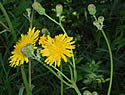 more plants
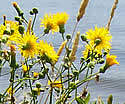 an infestation of Perennial Sowthistle with Reed Canary Grass
 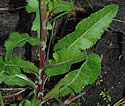 more lower leaves
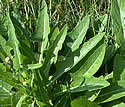 basal rosette of leaves
 botanical illustration, ca. 1919
 Perennial Sowthistle plant
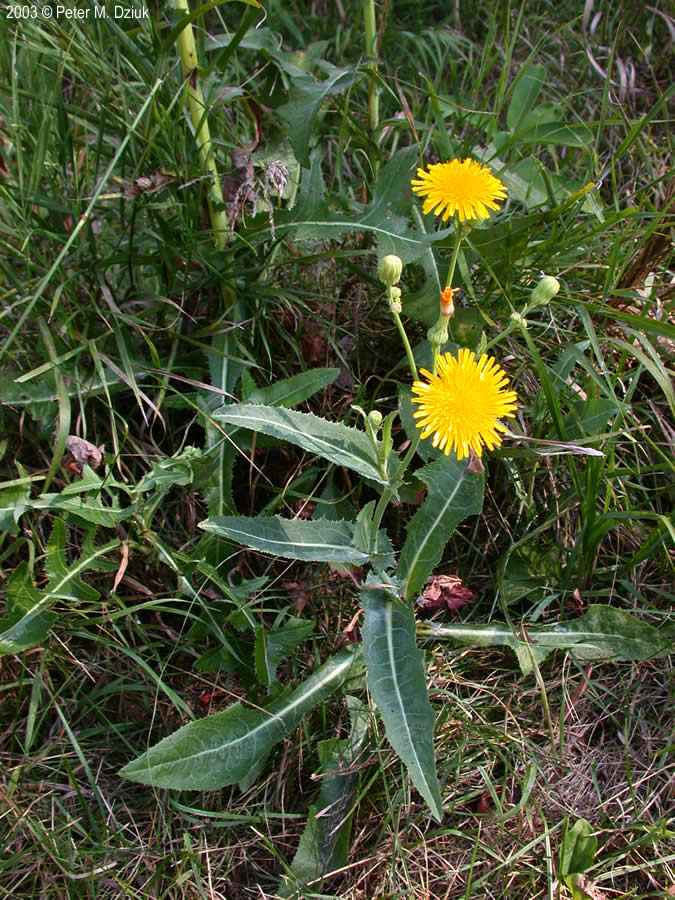 Perennial Sowthistle plant
 more plants
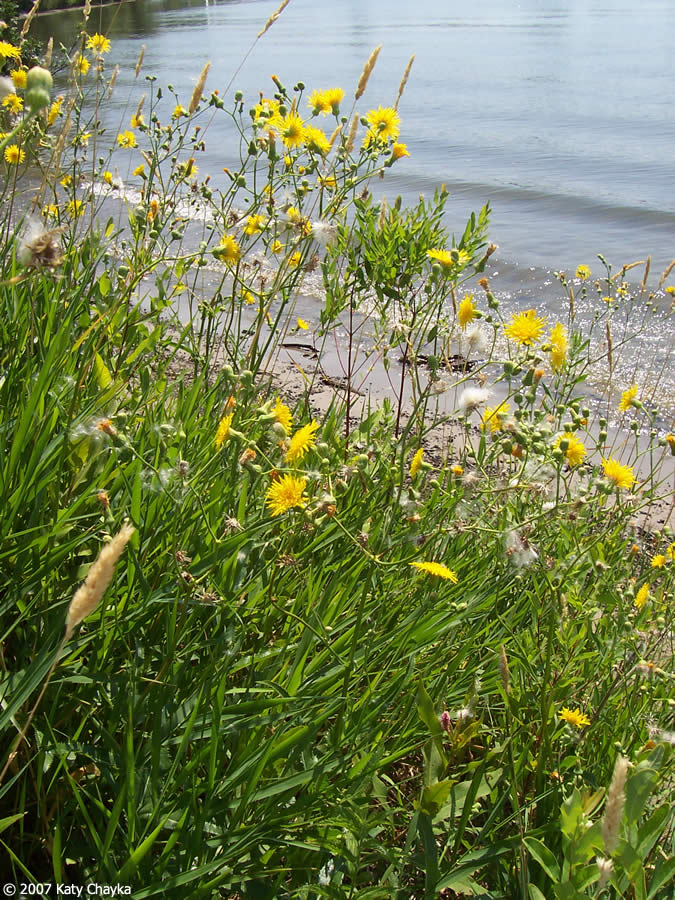 an infestation of Perennial Sowthistle with Reed Canary Grass
  more lower leaves
 basal rosette of leaves
 botanical illustration, ca. 1919
Photos by K. Chayka taken in Ramsey County. Other photos courtesy Peter M. Dziuk.
Comments
Have you seen this plant in Minnesota, or have any other comments about it?
on: 2010-07-09 14:48:10
Seen on the shore of Fish Trap Lake near Lincoln, MN on 7/8/10. Specifically, it was along the SE shoreline.
on: 2016-05-10 23:43:04
This one is growing in our lawn. Has been spreading outwards by rhizomes, so there are plants scattered over several square feet. The rhizomes and taproots are brittle, so this is one plant I'm considering using Roundup on rather than attempting to dig up. Very nasty. If you discover you have a perennial sow thistle (the other species are annual), get rid of it as quickly as possible so it doesn't spread.
on: 2019-09-04 15:26:39
Extending my shoreline buffer, this showed up. Was hoping it was Narrow-leaf hawkweed, but it is not. Similar, but this one has various length petals.