

Monotropa uniflora (Indian Pipe)
| Also known as: | |
|---|---|
| Genus: | Monotropa |
| Family: | Ericaceae (Heath) |
| Life cycle: | perennial |
| Origin: | native |
| Habitat: | part shade, shade; moist rich woods, acidic soil, often under pines |
| Bloom season: | June - September |
| Plant height: | 4 to 10 inches |
| Wetland Indicator Status: | GP: UPL MW: FACU NCNE: FACU |
| MN county distribution (click map to enlarge): |  |
| National distribution (click map to enlarge): | 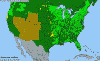 |
Pick an image for a larger view. See the glossary for icon descriptions.
Detailed Information
Flower: 
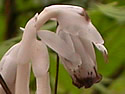
![[photo of flower]](/udata/r9ndp23q/pd/monotropa-uniflora-072017-8.jpg) Single flowers ½ to 1 inch long nod bell-like from the end of each stem. The 4 to 6 (usually 5) translucent white petals are barely discernible from the reduced sepals and faint, scale like leaves that fall over the flower head. All parts of this frail, ghostly plant blacken quickly from bruises and the dry air.
Single flowers ½ to 1 inch long nod bell-like from the end of each stem. The 4 to 6 (usually 5) translucent white petals are barely discernible from the reduced sepals and faint, scale like leaves that fall over the flower head. All parts of this frail, ghostly plant blacken quickly from bruises and the dry air.
Leaves and stem:
![[photo of leaves]](/udata/r9ndp23q/pd/monotropa-uniflora-45.jpg) Leaves are non-functional and have reduced down to frail, lose scale-like appendages along the stem and are less than one inch in length. Stems occur singly or in dense clusters from the roots, break easily when new, and are translucent white like the flowers.
Leaves are non-functional and have reduced down to frail, lose scale-like appendages along the stem and are less than one inch in length. Stems occur singly or in dense clusters from the roots, break easily when new, and are translucent white like the flowers.
Fruit:
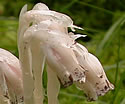
![[photo of fruit]](/udata/r9ndp23q/white/monotropa-uniflora-indian-pipe_0328_123358.jpg) During seed set and capsule formation, stem dries down to a twig-like stalk with an upturned seed capsule that can persist into the next growing season.
During seed set and capsule formation, stem dries down to a twig-like stalk with an upturned seed capsule that can persist into the next growing season.
Notes:
This species can be found throughout the forested eastern half of Minnesota and I've observed them frequently throughout my woodland wanderings. Like its closely related species, Hypopitys monotropa (Pinesap), it produces no chlorophyll, and like fungi, is not dependent upon light and can thrive in the shadiest of places. Since it cannot produce its own food it is sustained by the green plants around it. This relationship is not direct as its roots cannot directly tap into the food resources of other plant roots. The transfer is facilitated by mycorrhizal fungi that connect into both host and recipient roots and carbohydrates are passed along. This fungi dependent relationship is called mycotropism.
Native Plant Nurseries, Restoration and Landscaping Services ↓
Map of native plant resources in the upper midwest


More photos
 Indian Pipe plants
 Indian Pipe plants
 Indian Pipe plants
 Indian Pipe plants
 emerging in early summer
 flowers turn up during seed set
 blackened flower petals
 Indian Pipe plants
 Indian Pipe plants
 Indian Pipe plants
 Indian Pipe plants
 emerging in early summer
 flowers turn up during seed set
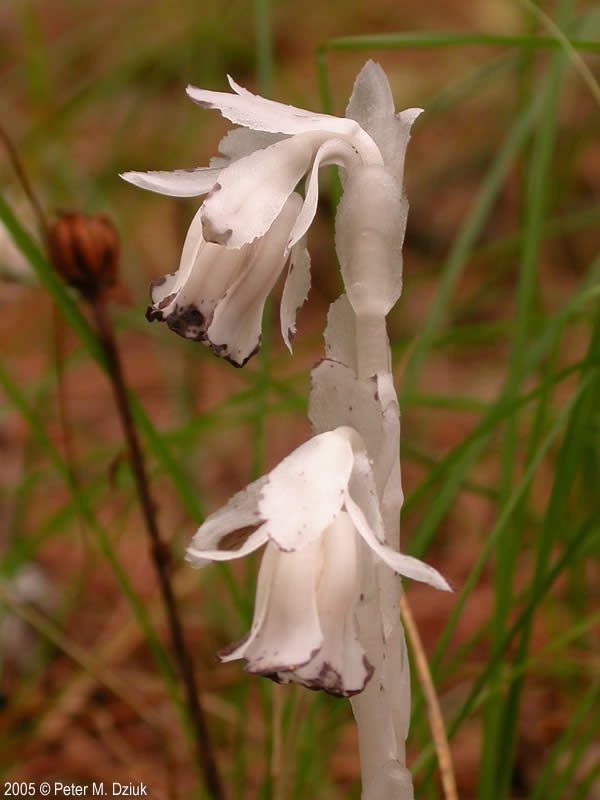 blackened flower petals
Photos by K. Chayka taken in Cass County. Photos by Peter M. Dziuk taken at Savanna Portage State Park.
Comments
Have you seen this plant in Minnesota, or have any other comments about it?
on: 2010-07-20 19:17:47
I saw some of these growing on the South Shore Campground and near the canoe storage at Camp Unistar on Star Island in Cass Lake
on: 2010-08-19 11:01:12
I thought it was a mushroom and included it my 'Northwoods Schrooms' YouTube. I took some nice closeups. What a curious plant it is!
on: 2010-10-22 12:36:12
Our group saw two or three clusters of these around the 4th of July 2010, two days after heavy amounts of rain. Like Lynn, we thought they were mushrooms as first. Good thing we didn't touch them. I hear they are very delicate.
on: 2011-08-17 18:55:08
We saw 3 freshly up clusters on the Dakota Trail. 6 different mushroom species were nearby. Aug. 16, 2011.
on: 2011-09-17 21:39:48
My two sons and I were building a fort out in the woods when this plant caught my eye. I've never come across this and I grew up in these woods. Thank you for the information on this plant.
on: 2012-02-22 14:01:50
wow i always though that they where a fungus of some type
on: 2013-08-14 18:54:45
Saw a clump of these near a campsite on Cherokee Lake in the BWCA.
on: 2013-11-28 12:02:45
i am flabbergasted i love this plant it looks so cool
on: 2014-07-10 20:53:08
Found this hiking through the woods on private property 3 yrs ago. Wish I had a landmark to find it again. But had my camera!
on: 2014-08-03 17:46:04
Just found a number of these just outside of town.
on: 2014-08-12 07:32:08
I saw a group of three or four of these yesterday while clearing brush along the roadside.
on: 2014-08-19 16:04:25
We found many of these amazing flowers scattered in clumps in the Uppgaard WMA in Ideal Corners near Crosslake. I also expected them to be in the mushroom family.
on: 2014-09-05 16:18:31
On 9/5/2014, I found and photographed Indian Pipe during a hike through the Faribault Nature Center. The recent wet weather has produced a boom in different species of mushrooms. I also saw dozens of different species of mushrooms during a recent hike through Father Hennepin State Park but no Indian Pipe. The plants in the Faribault Nature Center were growing under oak trees in the leaf litter. It is definitely an interesting plant!
on: 2014-09-08 10:17:32
We have several clumps of these growing on our property, under a stand of white pine and oak.
on: 2015-07-12 12:07:54
I don't know if conditions were prime last year, but found in several locations in nearby wooded area.
on: 2015-07-22 01:43:35
This are up now in Elm Creek park reserve. Some good patches of these. I was thinking these were fungi!
on: 2015-09-03 09:50:45
This years growth was not as good as last year. They are in the pine straw in the shadiest part of my lot. There were both pink and white last year, only white this year.
on: 2016-07-17 19:23:05
Today was the first time I've seen them in our yard at the cabin! It's been a wet spring/summer.
on: 2016-07-20 13:55:59
First time I've ever seen this plant, other than in books!! Very, very interesting ! Lots of shade, lots of decaying trees.
on: 2016-08-05 04:04:33
Saw this morning along the Cascade River Trail near Grand Marais. First time I ever saw one! Heavy rain earlier in the day.
on: 2016-08-10 13:21:49
A friend pointed out the Ghost Plant to me, on a walk toward a hiking trail of Superior National Forest not far east of the lake. The lake is in the vicinity of Wolf Ridge near Finland, MN
on: 2016-08-15 11:50:37
We saw several clusters this morning, August 15, 2016.
on: 2016-08-19 00:18:56
found by lake next to a rotting log not to far from a white pine
on: 2016-08-25 12:01:53
Two Step Falls trail in Tettegouche State park
on: 2016-08-30 15:36:50
Found this plant in the "fruiting" stage last week at Chubb Lake where we were visiting friends who own property on this lake. I have a picture to verify. Judie
on: 2016-09-04 20:19:14
Found many clusters (> 40 in several locations) under oaks and maples on our farm near Sogn Valley in Goodhue County.
on: 2016-09-05 07:35:40
The campground host and I saw Indian Pipe along the trail, just off the trail actually. I have taken photos and posted to the Minnesota State Parks website. I observed them 9/03/16.
on: 2017-05-18 16:32:33
I had this in my backyard in 2014. I didn't know what it was at the time and ended up mowing over it. I've looked for it on our property every summer since and haven't found it.
on: 2017-07-24 09:38:28
Thinking this was some type of mushroom I took some photos of this and sent them to MN Conservation Volunteer. They informed me it is a wild flower and not a mushroom. They are really cool!
on: 2017-07-25 16:40:50
Belle Prairie Park is situated within the Anoka County Sandplain. The park is managed by Morrison County in partnership with Great River Greening in an effort to restore oak savanna. As a lifelong resident of the area, today was the first time I've seen Indian Pipe growing at this location.
on: 2017-07-27 12:39:22
Our woods are north facing, dense, and full of springs. I was searching for new specimens of fungi and I ran across a single Indian pipe plant. There probably are more.
on: 2017-08-03 13:18:37
I found them on a side trail near the Trezona.
on: 2017-08-06 09:39:00
We have quite a few Indian Pipe plants in our backyard. The first time I noticed them was about four years ago. They have not came up every year. When they dry up they turn black. The dried up ones from last year are still standing.
on: 2017-08-20 19:04:13
I have a lot of this in my yard right now, never saw it before and suddenly it's coming up in patches all over the place. Spectacular. We have sandy soil, well shaded, heavily vegetated with jack pine, red pine, and hazelnut. Also plenty of puff ball mushrooms this year, other fungi I've never seen before.
on: 2017-08-24 10:44:09
I came across a tight cluster of about 12 by the side of the path that I have walked for 50 years, never seen these before. I have good pictures.
on: 2017-08-24 19:49:03
Very interesting looking plant,kind of alien looking. Caught our attention!
on: 2017-09-04 00:03:04
Top of a section of ravine behind Minnesota State University, Mankato. Not too far from a mowed area into a mix of hardwood and cedar.
on: 2017-09-19 10:10:45
We saw two of these near the boardwalk on our way back from a hike and not far from the visitors canter. They were in the thick of the forest undergrowth yet very visible!
on: 2017-09-24 19:16:44
Noticed this little beauty on the ski trails in Cascade River State Park in late September. They were growing in a very wet forested area.
on: 2018-06-21 07:44:59
I've seen this for years, but didn't realize until last year, they are completely upright near end stage. They it was a different plant. Some pink and some white.
on: 2018-07-02 16:24:25
I found them while out in the woods on our property. A treasure to find for sure.
on: 2018-07-27 21:24:32
First time ever seeing this plant - other than pictures - found plants in several locations aling the "River Walk" at the Minnesota History Forest Center. There are many large red and red pines in the area.
on: 2018-08-05 07:02:41
I saw a patch of these this morning near the path by the lake, below the Lodge. I've heard of these since I was a kid, but I'd never seen any until today.
on: 2018-08-14 21:13:07
I saw these during our hike up Eagle Mountain and also along the Middle Falls Trail at Grand Portage State Park.
on: 2018-08-22 12:02:50
Saw these on the superior hiking trail, thought they were fungus, with strange white stems and olive and smokey yellow colors it was quite striking. I have never seen these before, but they seem quite common.
on: 2018-08-29 22:25:24
Spotted these beauties last week and this week at Oxbow Park in southern MN--a surprising find here! In very moist deciduous forest and not under pines. Only one very small section of the trail that they are appearing on, but there were more this week (Aug. 29th) than last!
on: 2019-07-29 10:21:21
First time I've seen them and had to post a picture on the KAXE-KBXE Season Watch Facebook page to have someone identify for me. What a unique plant!
on: 2019-10-07 20:09:20
On trail between south overlook and campgrounds in hardwood forest
on: 2020-01-15 21:00:44
Interesting plant! I came upon it in the woods near my campsite September 2019 at Cascade River State Park.
on: 2020-07-20 19:34:14
July 20. 2020. Having something of a drought in the months before July, then recently some thunderstorms and several inches of rain on several occasions, two small clusters of these appeared in their usual spots underneath a small birch tree in a front yard two houses down the avenue from my house. Some years they don't make an appearance, some years they do. They're in the lawn about 15 ft. off the road. In past years, I've also seen several clumps of them around the corner and 270 feet up the street from my house, at the edge of the woods.
on: 2020-07-24 18:43:11
Just emerging along the road on our property in Tofte.
on: 2020-07-25 12:28:49
My husband noticed a little patch in our woods yesterday. We've never seen Indian Pipe before and were excited to have something so interesting growing in our yard. We will watch for them again, especially after a few days of rain.
on: 2020-08-01 16:10:20
I saw quite a few bunches of these at Afton State Park August 1st, 2020. Seemed to be very happy growing in thick beds of Oak leaves
on: 2020-08-11 16:05:11
We found these delicate beauties in our yard under heavily shaded white pine, they sprung up after some very dry weather followed by a drenching rain. A lovely and interesting plant which I had never seen before.
on: 2020-08-23 15:05:42
We see them every year in an old wood forest on the south west side of lake mtka near a marsh. They just started coming up about a week ago and there tend to be a dozen or two clusters depending on the year. A welcome sight each August.
on: 2021-05-28 16:30:08
In August 2020 I saw a clump of monotropa uniflora in Beltrami Co. near Swenson Lake (about 10 miles east of Bemidji), and took a good photo of them.
on: 2021-06-30 06:28:36
I found one of these a few years ago growing at the base of a sugar maple on the edge of a lake. Super interesting little plant! I thought it was some sort of fungus at first. I also saw some last year at Afton State Park.
on: 2021-07-01 21:23:53
I found one of these a few years ago growing at the base of a sugar maple on the edge of a lake. Super interesting little plant! I thought it was some sort of fungus at first. I also saw some last year at Afton State Park.
on: 2021-10-14 11:09:01
Seen at different times always catches the eye, odd & different.
on: 2021-10-26 22:11:12
I found these on my property. I live on the western edge of General CC Andrew's forest. So beautiful.
on: 2022-08-10 20:20:22
I guess we are to call this `ghost plant `. We find it blooming now along most trails at. NEILSON SPEARHEAD CENTER.
on: 2022-09-03 20:38:44
Spotted some nice clusters of these in the picnic area of Sakatah State Park on September 3rd, 2022, under hazelnuts. Quite the treat to see them outside of my college textbook for the first time!
on: 2022-09-04 10:46:16
I have seen this plant down our road here in Princeton, Mn. First time I have seen one. Very unique.
on: 2022-09-05 22:08:54
I came across a group of maybe 2 dozen clumps of multiple plants today. They were growing under several white pine trees that were planted 23 years ago on a north-facing slope. Heavy shade from the trees and some undergrowth. Very evocative of silence and mystery.
on: 2022-09-09 01:14:19
I found a patch of these near the walking path not far from the Lake Camelot kids park right off co rd 47. So cool!
on: 2023-07-23 21:57:09
This amazing flower caught my eye along the scenic overlook path...what a N intriguing find!
on: 2023-07-30 18:15:45
Are there any gardens that have them for sell in Anoka? This plant would be nice to have for my bugout bag
on: 2023-07-30 18:33:29
Dylan, this is very difficult to propagate, if not impossible, requiring very specific soil and fungal conditions to germinate and grow. You won't find it commercially available for that reason. Transplanted plants inevitably die so don't bother taking any from the wild.
on: 2023-09-20 20:47:36
Spotted something white on the floor of deciduous woods in Red Wing on August 30, 2023. Discovered small colony of Ghost Pipe. Had previously only seen one plant in 2021 in different area of our property. Drought conditions both summers.