

Ranunculus fascicularis (Early Buttercup)
| Also known as: | Tufted Buttercup |
|---|---|
| Genus: | Ranunculus |
| Family: | Ranunculaceae (Buttercup) |
| Life cycle: | perennial |
| Origin: | native |
| Habitat: | part shade, sun; dry prairies, open woods |
| Bloom season: | April - May |
| Plant height: | 4 to 12 inches |
| Wetland Indicator Status: | GP: FAC MW: FACU NCNE: FACU |
| MN county distribution (click map to enlarge): | 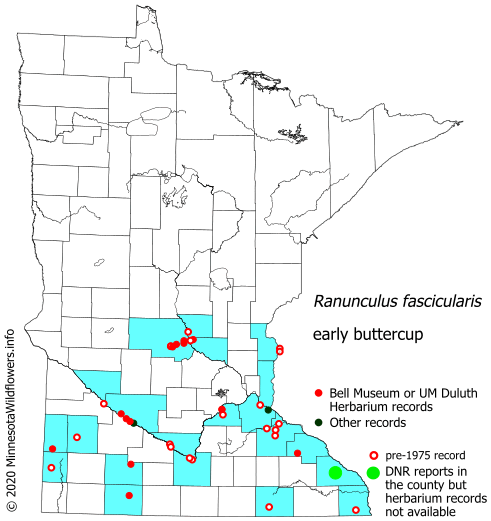 |
| National distribution (click map to enlarge): |  |
Pick an image for a larger view. See the glossary for icon descriptions.
Detailed Information
Flower: 
![[photo of flower]](/udata/r9ndp23q/yellow/early-buttercup_0411_163145.jpg) Usually a single flower, occasionally more, at the end of a hairy stem. Flowers are ½ to 1 inch across with (usually) 5 shiny yellow petals rounded at the tip and streaked with green at the base. Petals are typically longer than wide but the width can vary greatly, perhaps with age.
Usually a single flower, occasionally more, at the end of a hairy stem. Flowers are ½ to 1 inch across with (usually) 5 shiny yellow petals rounded at the tip and streaked with green at the base. Petals are typically longer than wide but the width can vary greatly, perhaps with age.
![[photo of hairy sepals]](/udata/r9ndp23q/pd/ranunculus-fascicularis-23.jpg) Behind the petals are 5 yellowish-green sepals, shorter than the petals, with pointed tips and also covered in spreading to appressed hairs. Numerous yellow stamens surround the yellowish center that turns green with maturity. A plant has 1 to several flowers.
Behind the petals are 5 yellowish-green sepals, shorter than the petals, with pointed tips and also covered in spreading to appressed hairs. Numerous yellow stamens surround the yellowish center that turns green with maturity. A plant has 1 to several flowers.
Leaves and stems:
![[photo of leaves]](/udata/r9ndp23q/yellow/early-buttercup_0403_171611.jpg) Leaves are mostly basal, mostly compound in groups of 3 or 5, on stalks up to 4 inches long. Leaflets are up to 1 inch long, mostly lobed in 3 to 5 parts, with lobes often further divided or notched, and blunt or rounded tips, sometimes with a tiny sharp point. Leaf surfaces are variously hairy, sometimes smooth.
Leaves are mostly basal, mostly compound in groups of 3 or 5, on stalks up to 4 inches long. Leaflets are up to 1 inch long, mostly lobed in 3 to 5 parts, with lobes often further divided or notched, and blunt or rounded tips, sometimes with a tiny sharp point. Leaf surfaces are variously hairy, sometimes smooth.
![[photo of leaf hairs]](/udata/r9ndp23q/yellow/ranunculus-fascicularis-early-buttercup_0417_151127.jpg) Leaf stalks and flowering stems are variously covered in spreading to appressed hairs but may become smooth with age. The few alternate leaves on the flowering stems are mostly lobed in 3 narrow parts.
Leaf stalks and flowering stems are variously covered in spreading to appressed hairs but may become smooth with age. The few alternate leaves on the flowering stems are mostly lobed in 3 narrow parts.
Fruit:
The flower center expands to a round to oval seed head about 1/3 inch long. Seeds are smooth with a persistent beak.
Notes:
The common name Early Buttercup is appropriate, as it is probably the first yellow buttercup to bloom in spring. It is typically found growing in scattered colonies. Several references say the petals are narrow, but there was a wide disparity in the populations where these photos were taken. The early leaves might be mistaken for Ranunculus hispidus (Hispid Buttercup), but that is a much larger plant with larger leaves that are more sharply pointed, and likes moister habitats.
Native Plant Nurseries, Restoration and Landscaping Services ↓
Map of native plant resources in the upper midwest


More photos
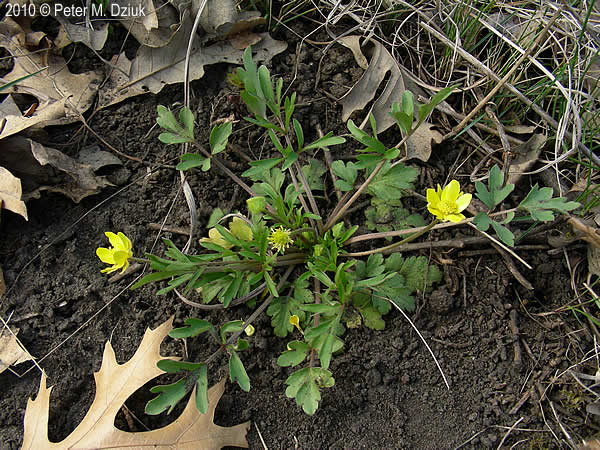 Early Buttercup plant
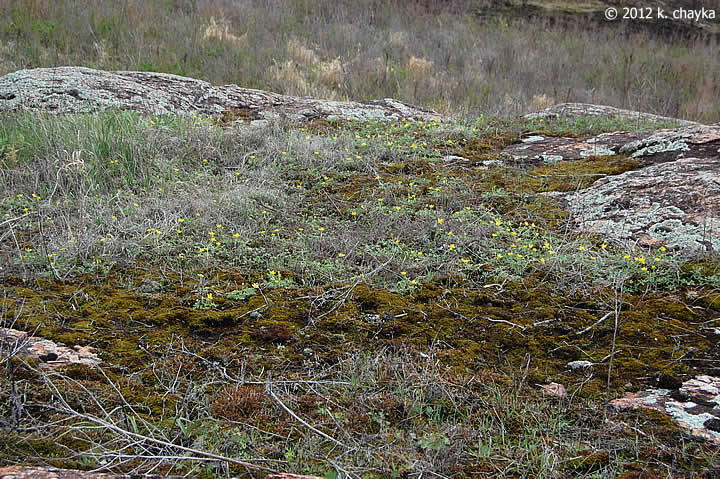 Early Buttercup in rock outcrop habitat
 more flowers
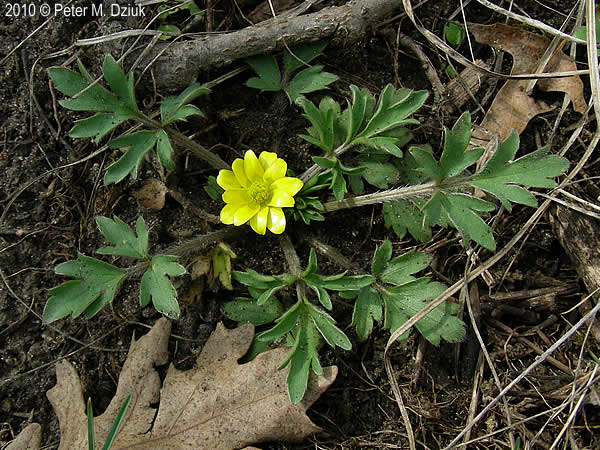 an unusual double flower
Photos by K. Chayka and Peter M. Dziuk taken at Vermillion Falls Park, Dakota County, and at a rock outcrop in Renville County.
Comments
Have you seen this plant in Minnesota, or have any other comments about it?
on: 2017-05-10 12:33:58
Identified a few scattered plants flowering 4/22 on the edge of an oak savanna and oak-hickory woodland over shallow sandstone in the Louisville Swamp Unit of the MN River Valley National Wildlife Refuge.
on: 2019-05-17 11:23:07
We have yellow flowers blooming in the swamps. Are they Butter cups?
on: 2019-05-17 12:16:53
June, most likely it's marsh marigold, which is in the buttercup family.
on: 2019-06-25 06:44:47
Near Hway 41 on the left side coming up from downtown Chaska. I found a very small stand in early June, now can't find it anymore. They looked like what the Germans call "Dotterblumen" - but the small type I grew up with. What in my youth I found in the Austrian Alps in swampy areas, for instance in the Kleinwalsertal-Vorarlberg mountains, were huge "Sumpfdotterblumen (Swamp Buttercups)," incredibly gorgeous, possibly under protection - they were not like these small ones I found for the first time in Minnesota. I am delighted that these small blooms are native - I did not read anything about invasive.
on: 2020-04-20 22:02:55
I found a few of these plants blooming on rock outcrops, on a hike on 19th April through the SNA
on: 2021-03-23 22:53:59
A friend sent me a picture of an early buttercup blooming Ranunculus fascicularis from The Nature Conservancy at Weaver dunes in Kellogg Minn. on March 23rd of 2021.
on: 2022-06-17 13:54:33
On 6-11-22 saw 3 plants somewhat like this. Have looked through your website and cannot find the exact thing. Unfortunately, my photo did not turn out good. Is about 1 foot high, each stalk has a single flower about 1/2 inch, 8 waxy light yellow petals - each curving in, no visible ray flowers or stamens. Growing in moist field with horsetail around it. Grass like leaves and wider basal leaves around it - can't see which belong to the plant. Any good ideas? I tried keying it with Newcomb's Guide but not quite like the Lesser Celandine.
on: 2022-06-18 08:43:22
Linda, that particular combination of characteristics does not sound familiar. If you have any other photos, post them on the Minnesota Wildflowers Facebook page for help with an ID.