

Mollugo verticillata (Carpetweed)
| Also known as: | Indian Chickweed, Devil's Grip |
|---|---|
| Genus: | Mollugo |
| Family: | Molluginaceae (Carpetweed) |
| Life cycle: | annual |
| Origin: | South or Central America |
| Status: |
|
| Habitat: | part shade, sun; roadsides, waste areas, disturbed soil, gardens |
| Bloom season: | June - September |
| Plant height: | 1 to 6 inches |
| Wetland Indicator Status: | GP: FAC MW: FAC NCNE: FAC |
| MN county distribution (click map to enlarge): |  |
| National distribution (click map to enlarge): | 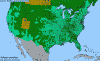 |
Pick an image for a larger view. See the glossary for icon descriptions.
Detailed Information
Flower: 
![[photo of flowers]](/udata/r9ndp23q/white/carpetweed_0717_103203.jpg) 2 to 6 flowers on slender stalks arising from leaf axils. Flowers are about 1/8 inch across with 5 rounded petal-like sepals, white on the upper side and green underside. 3 or 4 white to yellowish tipped stamens surround the green ovary in the center.
2 to 6 flowers on slender stalks arising from leaf axils. Flowers are about 1/8 inch across with 5 rounded petal-like sepals, white on the upper side and green underside. 3 or 4 white to yellowish tipped stamens surround the green ovary in the center.
Leaves and stems:
![[photo of leaves]](/udata/r9ndp23q/white/carpetweed_0731_095746.jpg) Leaves are whorled in groups of 3 to 8. Leaves are linear to nearly spoon shaped, ¼ to 1½ inches long, 1/8 to 2/3 inch wide, toothless and hairless, rounded or pointed at the tip, mostly stalkless. Stems are hairless, branching from the leaf nodes, swollen to varying degrees at the node. Plants are typically sprawling, spreading in all directions from the base.
Leaves are whorled in groups of 3 to 8. Leaves are linear to nearly spoon shaped, ¼ to 1½ inches long, 1/8 to 2/3 inch wide, toothless and hairless, rounded or pointed at the tip, mostly stalkless. Stems are hairless, branching from the leaf nodes, swollen to varying degrees at the node. Plants are typically sprawling, spreading in all directions from the base.
Notes:
The first time I came upon Carpetweed I thought it resembled a Bedstraw with 5-petaled flowers. The origin of this species is debatable but a common theory is it is not native and migrated north from South America. I have most often encountered it in sandy soils, but it is apparently not very particular about its habitat and grows most anywhere in dry to moist soil. A plant can spread rapidly, forming patches up to 20 feet in diameter.
Native Plant Nurseries, Restoration and Landscaping Services ↓
Map of native plant resources in the upper midwest


More photos
 Carpetweed plant
 sprawling Carpetweed plant
 a mat of Carpetweed
Photos by K. Chayka taken at Wild River State Park, Chisago County, and Coon Rapids Dam, Anoka County. Photos courtesy Peter M. Dziuk taken in Anoka County.
Comments
Have you seen this plant in Minnesota, or have any other comments about it?
on: 2016-06-28 13:36:41
A month ago it seemed to be all Hop Clover in the street and curb cracks. Now it looks like carpetweed is prevailing.
on: 2018-09-25 20:23:18
Pulled them while weeding for folks I was visiting. Retain some as specimens which were pressed. Will probably end up at EKY. 2nd week of July 2018
on: 2022-07-11 10:06:28
tiny star-like flowers are pretty. in my pathways. wondered if native & i should leave them. thought it was a galium, but they have 3-4 petals. adv search brought me to this page i will pull them